Aluminum Pergola CE & EN 1090-1 Compliance Guide
Pergola Buyer Guides
Aluminum Pergola CE Marking & EN 1090-1 Compliance: A Guide for EU Importers
To sell aluminum pergolas in EU countries, products must bear the CE mark; the regulatory basis for CE certification of aluminum structures is the EN 1090-1 standard.
In practice this means the manufacturer must run a Factory Production Control (FPC) system and hold valid Initial Type Testing (ITT).
This guide explains what the standard covers, the CE pathway, and exactly how EU importers can verify a supplier’s claim before signing.
Why CE Marking Matters for Aluminum Pergolas in the EU
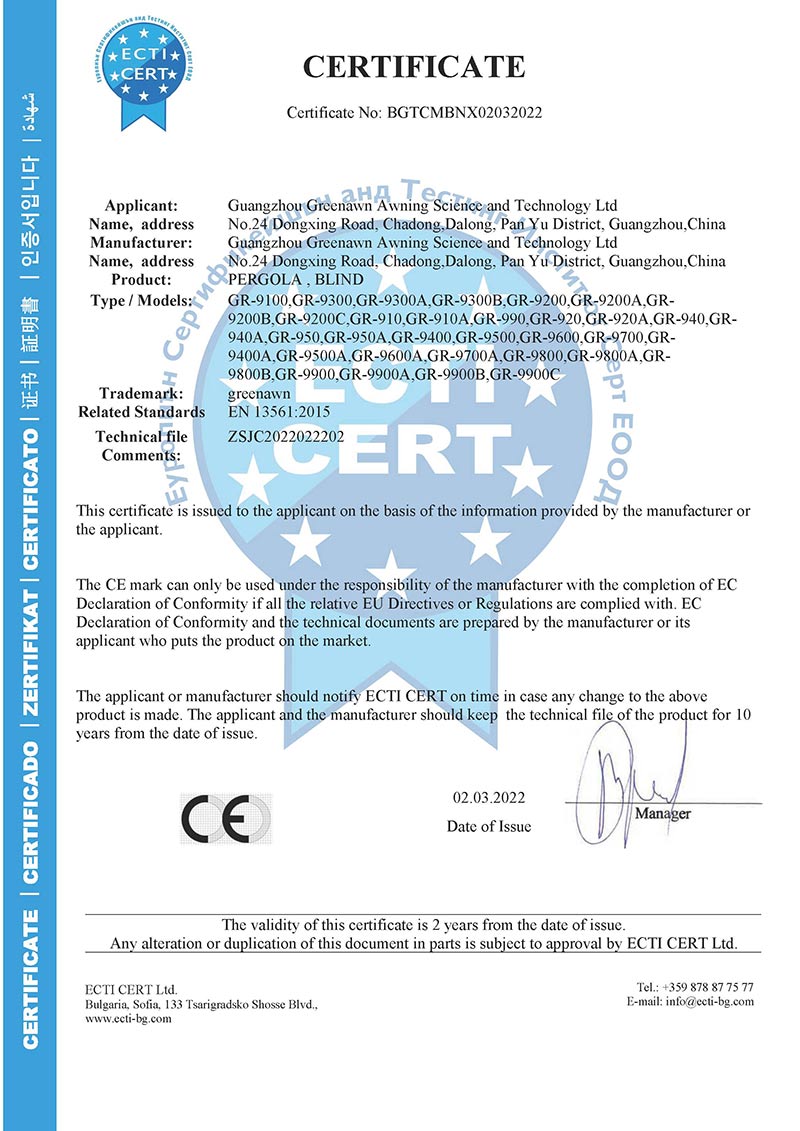
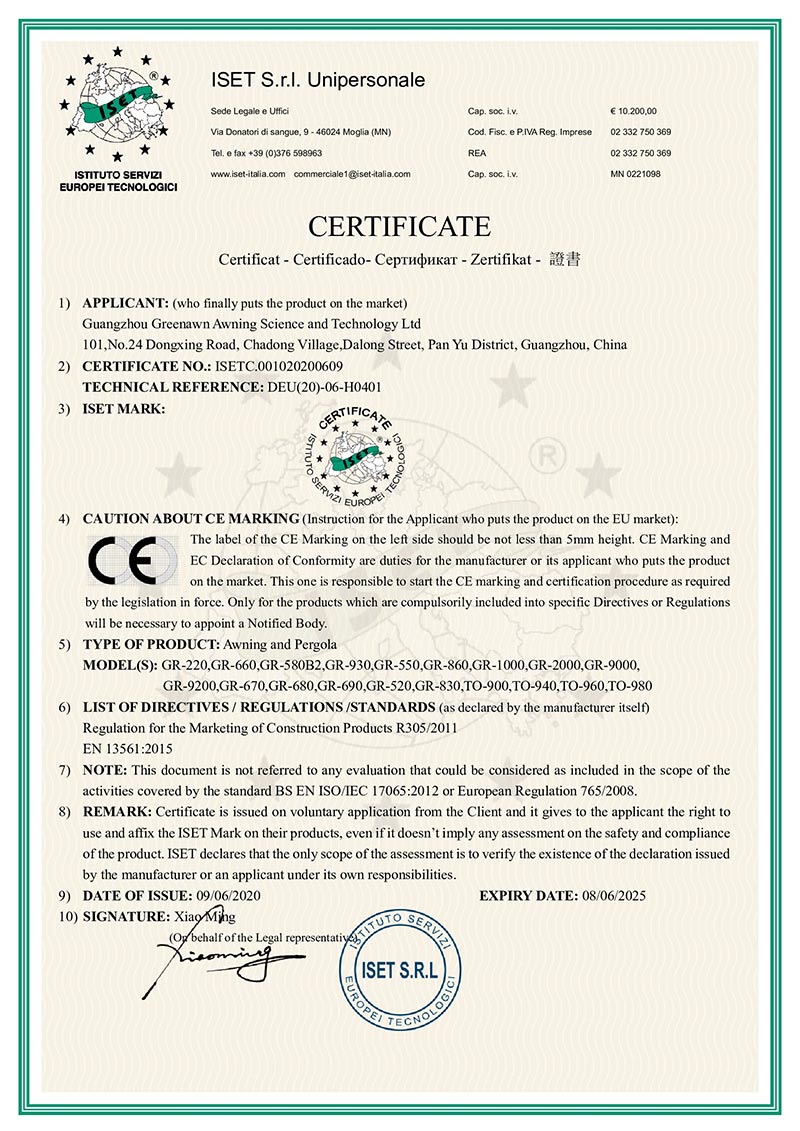
The EU Construction Products Regulation (CPR, Regulation 305/2011) makes CE marking mandatory for construction products placed on the EU market. A pergola built from aluminium extrusions is treated as a structural aluminium component, so without a valid CE mark it cannot be customs-cleared for compliant building use, and architects or contractors specifying it take on unquantified compliance risk.
For an importer, the CE mark shifts that risk onto the production side. A supplier holding EN 1090-1 is declaring, through a Notified Body audit, that its manufacturing process is controlled and its declared product performance is backed by testing. That is why CE status is usually the first gate in any EU distributor or contractor qualification process — before price, before lead time, before finish colour.
What EN 1090-1 Actually Covers (and What It Doesn't)
EN 1090-1 — Execution of steel and aluminium structures — Part 1: Requirements for conformity assessment of structural components — is the harmonised standard that lets aluminium structural components receive CE marking under the CPR. It defines the technical requirements for manufacturing and assembling structural parts: material traceability, FPC, initial inspection, and the qualification of welding and assembly personnel.
The honest boundary matters here. EN 1090-1 is an execution standard — it governs how consistently a product is made, not the full set of CPR clauses for a finished pergola, and not a European Technical Assessment (ETA). It also does not, by itself, issue a CE performance statement for a specific wind or snow load class. Greenawn holds EN 1090-1 certification and does not claim an ETA; load performance is demonstrated separately through third-party testing and the SGS test reports.
Understanding this distinction protects buyers. A certificate that says “EN 1090-1” tells you the plant is audited for consistency; it does not by itself tell you the louvered roof will survive a 1.0 kN/m² snow event at your site. You need both the execution certificate and the test evidence — which is the next two sections.
The CE Marking Pathway for Structural Aluminum
Four elements make up a defensible CE marking for an aluminium pergola structure:
- FPC (Factory Production Control) — a documented, audited quality system running on the production line. At Greenawn this is reinforced by ISO 9001 certification across both operating entities.
- ITT (Initial Type Testing) — first-article verification that the product meets its declared performance before series production.
- Welding / assembly personnel qualification — aligned with EN ISO 3834 quality requirements for fusion welding.
- DoP (Declaration of Performance) — the document shipped with the product that declares its essential characteristics under the CPR.
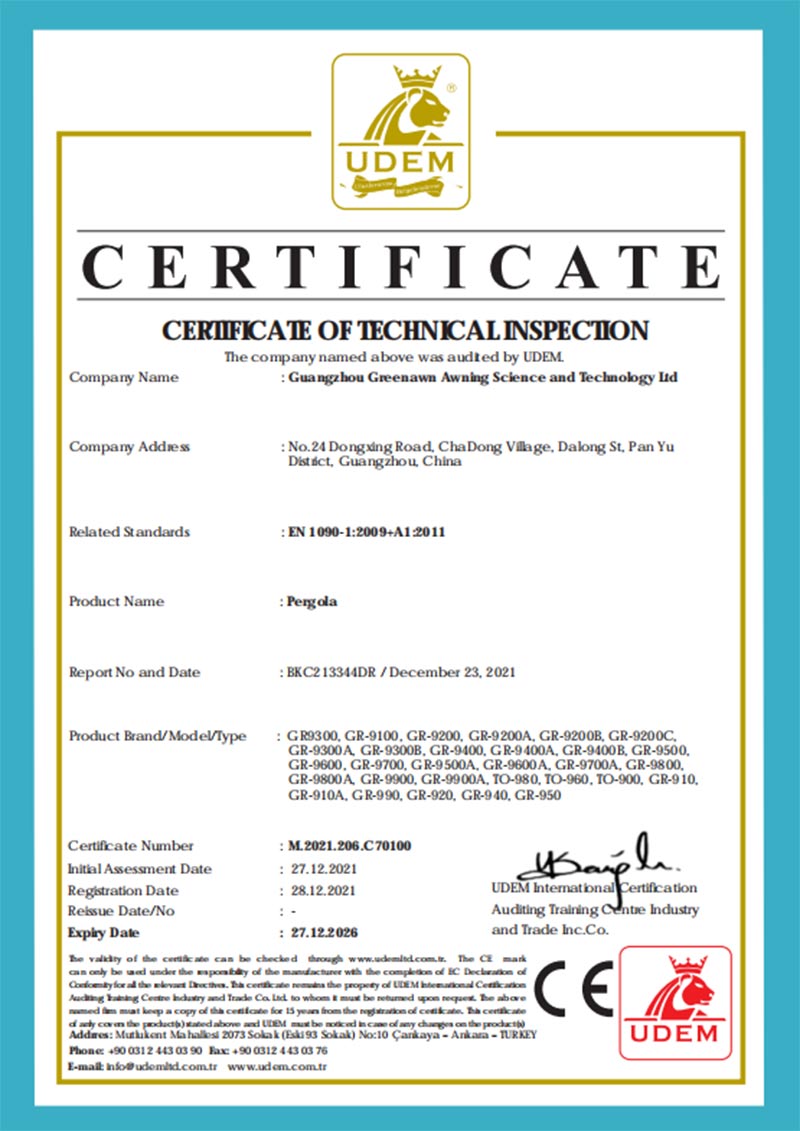
The standard itself is maintained by CEN and referenced through the EU’s harmonised standards list; the Notified Body that audits the FPC and signs off the system (for Greenawn, UDEM) is listed in the EU NANDO database. Importers should always be able to trace the certificate back to a real Notified Body number — if there is no number, there is no CE.
How Greenawn Meets EN 1090-1?
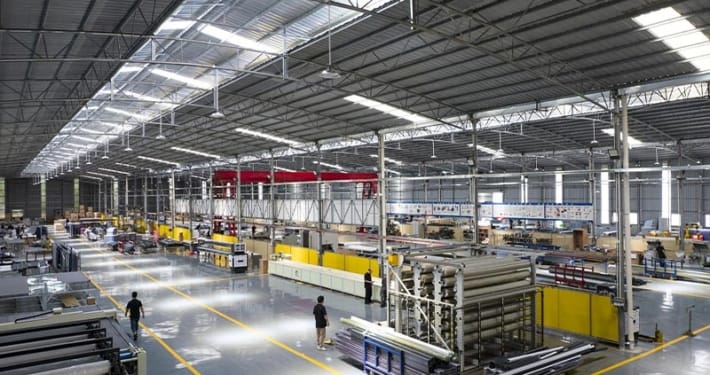
Greenawn is a 29-year aluminium pergola manufacturer. Our structural components are certified to EN 1090-1:2009+A1:2011, with the certification audited and issued by UDEM, a Notified Body. This is the execution-standard certificate that anchors our CE marking for EU-bound structures.
The certificate is backed by an independent test record, not just a paper system:
- Third-party structural testing by SGS (SGS-CSTC, an ISO/IEC 17025-accredited laboratory): model GR9200 (3000 × 3000 × 2505 mm) was wind-tunnel tested to Beaufort level 10 (≈ 55–63 mph / 89–102 km/h) with a PASS result, and subjected to a uniform top load of 80 kg/m² (720 kg over the 3 × 3 m bay) held for 60 minutes with no irreversible deformation.
- Material: 6063-T5 aluminium extrusions with a powder-coat finish — 60 µm coating thickness, 96-hour salt-spray resistance, and 5–7 year color-retention.
- Management system: ISO 9001 (both operating entities) and ISO 14001 support the FPC and sustainability narrative behind the CE claim.
Every shipment can be accompanied by the EN 1090-1 certificate and a signed test report.
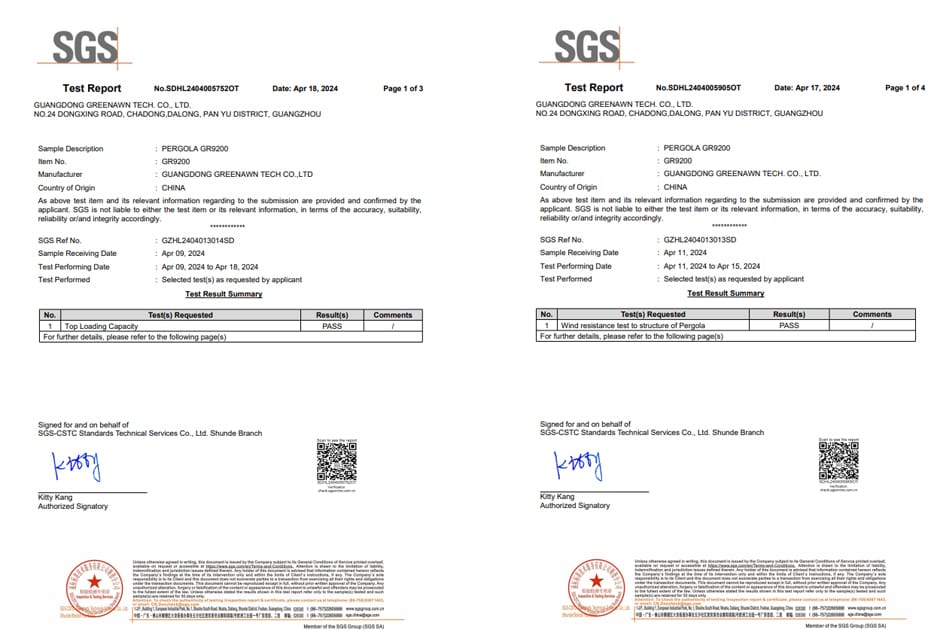
Supporting Structural Test Evidence
It is worth separating two things that get conflated: a CE certificate and a structural test report are different documents that play different roles. EN 1090-1 certifies the manufacturing system; the SGS reports certify the product performance. Neither replaces the other, and a credible EU supplier should be able to show both.
For the detailed test methodology — how dead, live, wind and snow loads are applied, what ASCE/IEC-aligned references mean, and how to read a load-test report — see our pillar guide on how aluminum pergolas are structurally tested. This page stays focused on the EU compliance pathway so importers get a clean verification checklist.
How EU Importers Verify a Supplier's EN 1090-1 Claim
Use this four-step check before committing to a supplier:
- Request the original certificate and the Notified Body number. UDEM (or any valid Notified Body) issues a traceable certificate; verify the body in the NANDO database .
- Check the standard version and scope. Confirm it reads EN 1090-1:2009+A1:2011 (or current amendment) and covers aluminium structural components, not just a generic quality mark.
- Cross-check the third-party test report. Match the SGS / ISO 17025 report number and sample model (e.g. GR9200) to the product line you intend to import.
- Watch for red flags. “Template CE certificates,” marks with no Notified Body number, or suppliers who cannot show ITT evidence should be disqualified regardless of price.
This checklist is self-contained: it does not depend on any other compliance page and works whether you are vetting Greenawn or a competitor.
Greenawn's EU Compliance Capability
Twenty-nine years of aluminium pergola manufacturing, an audited EN 1090-1 certificate from UDEM, SGS third-party structural tests, and ISO 9001/14001 systems together let Greenawn supply CE-marked structural pergolas to the EU market with a traceable evidence chain. We do not claim an ETA or CPR-wide product certification beyond what EN 1090-1 and the supporting tests substantiate — and we are transparent about that boundary.
Need certificate copies or SGS test reports for your qualification file? Contact us and our technical team will provide the exact paperwork for the models you plan to import.
FAQ
Is EN 1090-1 mandatory for pergolas in the EU?
Structural aluminium components placed on the EU market require CE marking under the CPR, and EN 1090-1 is the harmonised standard that provides the conformity-assessment route for those components. A pergola without it cannot be supplied as a compliant structural product.
Does EN 1090-1 cover wind or snow load ratings?
Not directly. EN 1090-1 governs manufacturing consistency (FPC, ITT, personnel qualifications). Load performance is demonstrated through third-party testing (e.g. SGS) and declared in the product’s test documentation — the two documents are complementary, not the same.
What is the difference between EN 1090-1 and a CE test report?
EN 1090-1 is the execution-standard certification of the manufacturing system, audited by a Notified Body. A CE test report (such as SGS) measures actual product performance under load. You need the certificate for market access and the report to prove the product performs.
Does Greenawn hold an ETA (European Technical Assessment)?
No — we do not currently hold an ETA. Our EU compliance is anchored by EN 1090-1 certification, supported by SGS structural testing and ISO 9001/14001 systems. We are transparent that ETA is not part of our current certification scope.
Related Posts
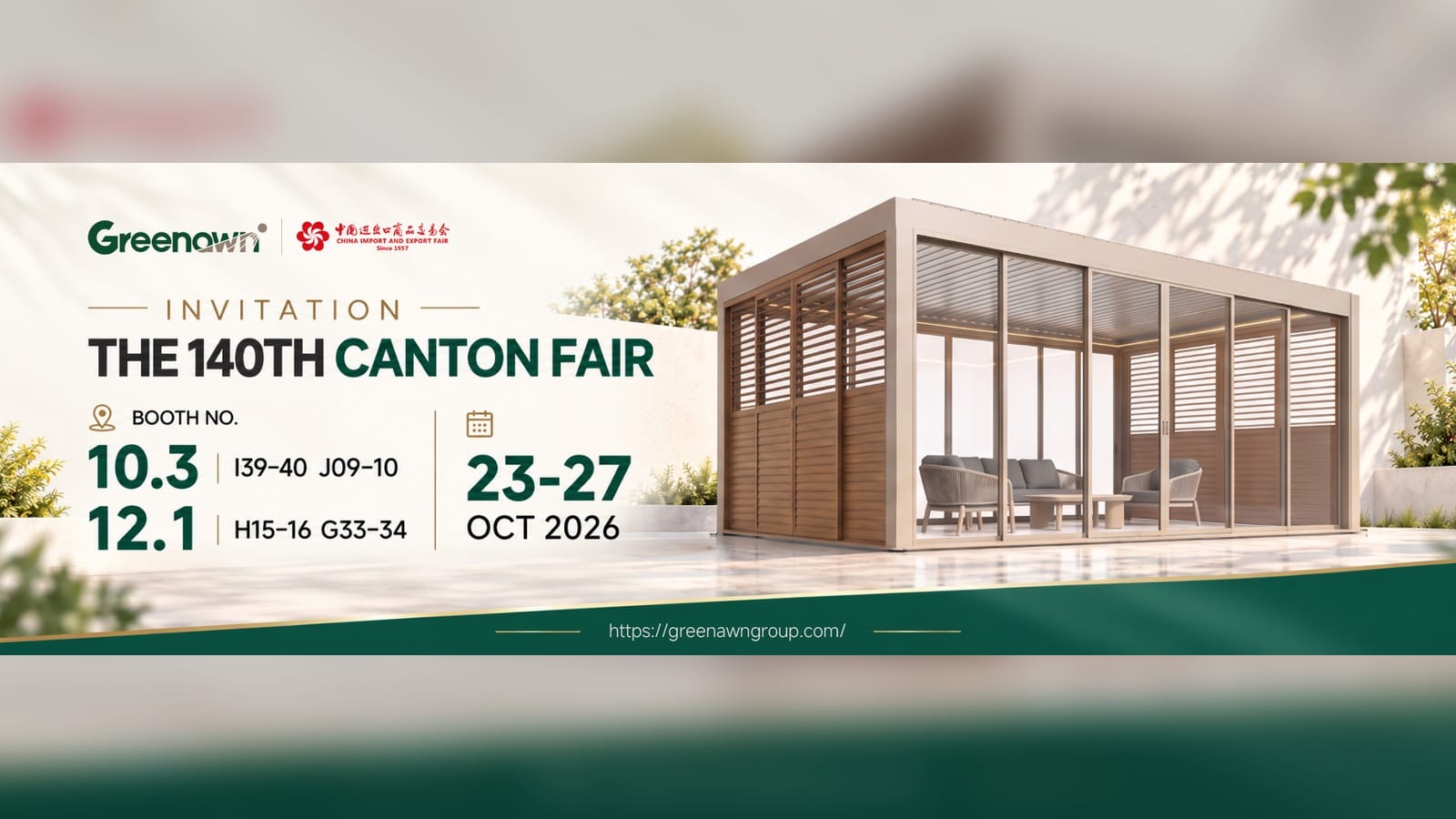
Meet Greenawn at the 140th Canton Fair – Oct 23–27, 2026
Meet Greenawn at the 140th Canton Fair – Oct 23–27, 2026 Greenawn is pleased to announce our participation in the

Aluminum Pergola Snow & Wind Load: Engineering Guide
Aluminum Pergola Snow & Wind Load: Engineering Guide A aluminum pergola is typically treated as a permanent outdoor structure for