Meet Greenawn at the 140th Canton Fair – Oct 23–27, 2026
Meet Greenawn at the 140th Canton Fair – Oct 23–27, 2026 Greenawn is pleased to announce our participation in the

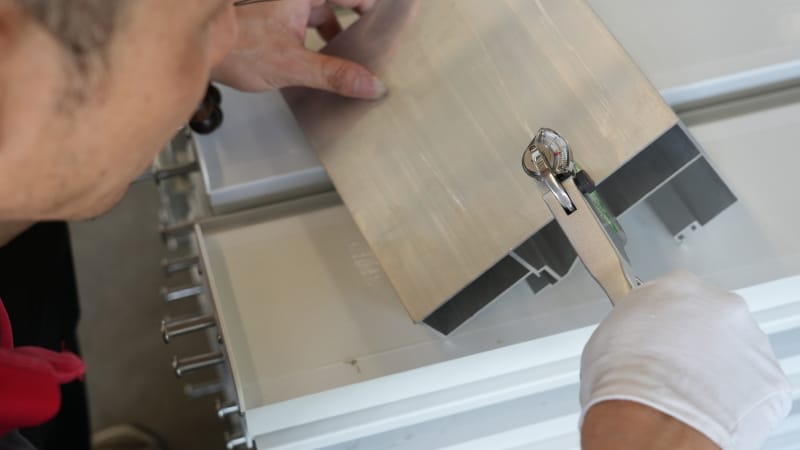
Structural load testing is the process that proves an aluminum pergola will stand up to what nature and occupants put on it. For contractors specifying a structure and importers sourcing from overseas factories, the test report — not the marketing brochure — is the document that matters.
This guide explains how aluminum pergolas are tested for structural loads, which standards apply in the US, EU, and Australia, and how to read and verify the report a supplier hands you.
An aluminum pergola looks simple: a few posts, beams, and a louvered or slatted roof. In service, however, it carries a combination of permanent and environmental loads that, if underestimated, lead to excessive deflection, loosened connections, or collapse during a storm. For the professionals who specify and import these structures, load testing underpins three things:
When a pergola fails in high wind, the first question is whether it was engineered to local load requirements. A tested, documented structure shifts that burden of proof to data rather than assertion.
Permit officers and customs brokers both respond to evidence. A third-party test report shortens the approval cycle on both ends of the supply chain.
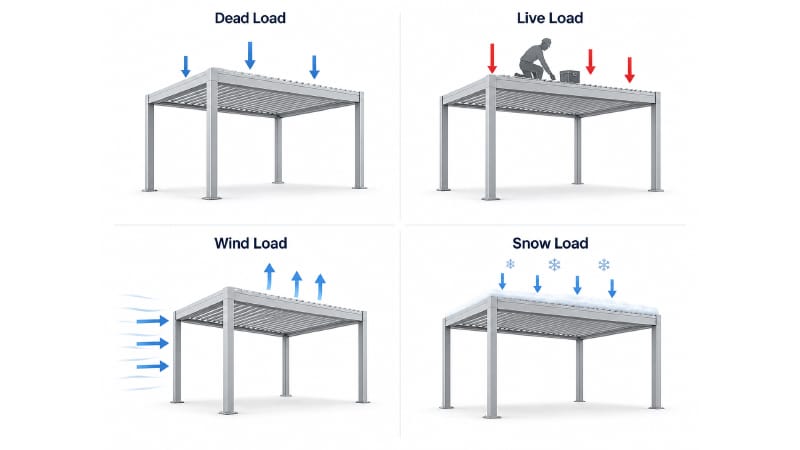
Every structural load test for an aluminum pergola resolves into four categories. The table below summarizes what each simulates and how it is typically evaluated.
Load type | What it simulates | Typical test method | Common acceptance reference |
Dead load | Self-weight of frame, louvers, motors, fixtures | Weighing + calculation | Design weight vs. rated capacity |
Live load | People, furniture, maintenance access | Static point/uniform load | Local code live-load value |
Wind load | Uplift, pressure, suction from storms | Pressure chamber / anchor pull | ASCE 7 wind map + IBC |
Snow load | Accumulated snow, drift, point loads | Uniform + point load rig | ASCE 7 / local ground snow load |
Dead load is the permanent weight of the structure itself — aluminum extrusions, the louvered roof mechanism, motors, and any fixed lighting or heaters. It is established by weighing components and confirmed against the structural model.
Live load covers everything temporary: a person walking the roof for maintenance, hung planters, or furniture beneath. Testing applies a distributed or point load and measures deflection against the allowable limit.
Inadequate wind resistance is the primary cause of structural failure in pergolas. Testing evaluates uplift at the anchors, inward and outward pressure on the roof, and suction on the soffits. Results are mapped to the site’s ASCE 7 wind speed and exposure category.
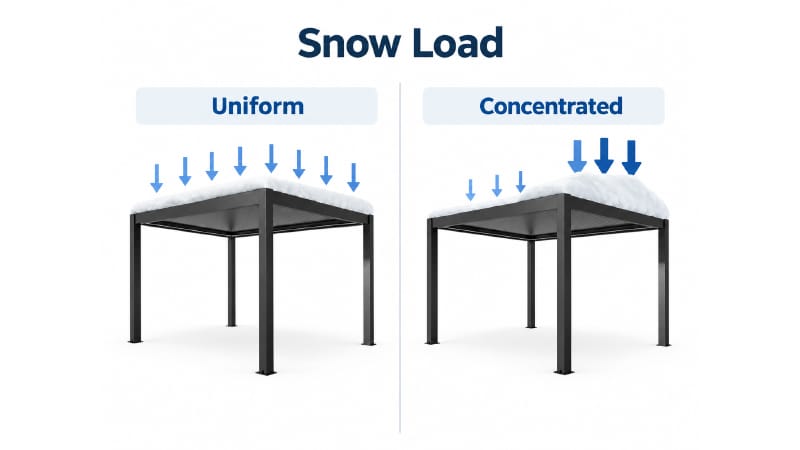
In colder markets, snow load dominates. Tests apply uniform load across the roof and concentrated point loads to simulate drift, measuring deflection and any permanent set after removal.
Aluminum pergola structural load testing combines several proven methods. The exact mix depends on the product and target market.
The frame is loaded gradually and deflection is measured at mid-span and at connections. A common acceptance criterion is deflection not exceeding L/240 (or the value specified by the applicable code) under design load, with no permanent deformation after unloading.
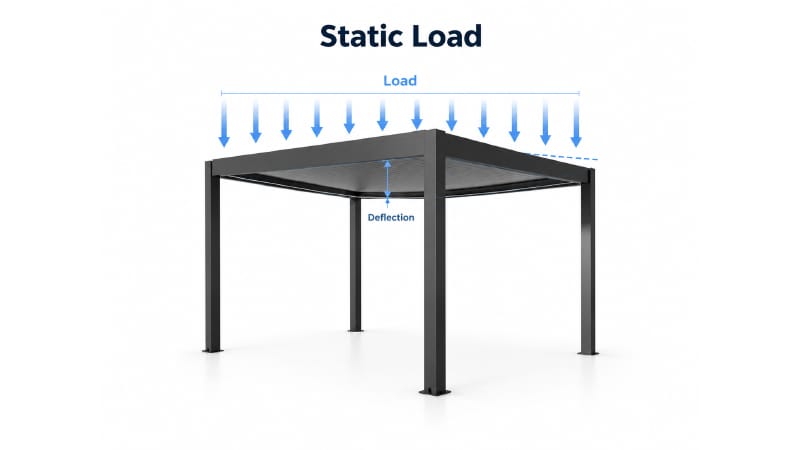
Roof assemblies are placed in a pressure chamber or anchored to a reaction frame and subjected to calibrated inward and outward pressure replicating design wind speeds. Standards such as ASTM E330 define uniform static pressure procedures for exterior assemblies.
A distributed load (sandbags, water bags, or pneumatic pads) simulates snow; a concentrated load simulates drift or a single heavy accumulation. The structure is loaded to the design value, held, and inspected for cracking, connection slip, or unacceptable deflection.
Moving parts — especially motorized louvers — are cycled open and closed thousands of times under load to confirm the mechanism and its fixings survive the product’s service life, not just a single static event.
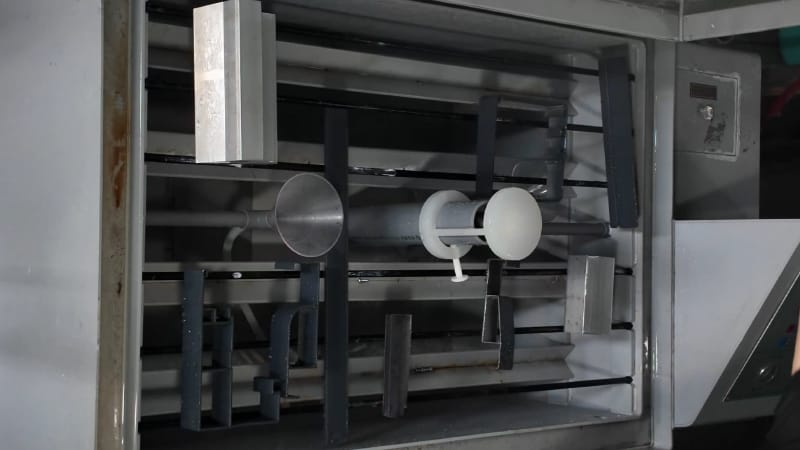
The aluminum itself is verified: alloy and temper (for example, 6063-T5 / 6063-T6), coating thickness, and salt-spray corrosion resistance per relevant ASTM or ISO methods. Material certificates back the structural calculations.
The credibility of a load test depends as much on which standard and whose lab as on the numbers themselves.
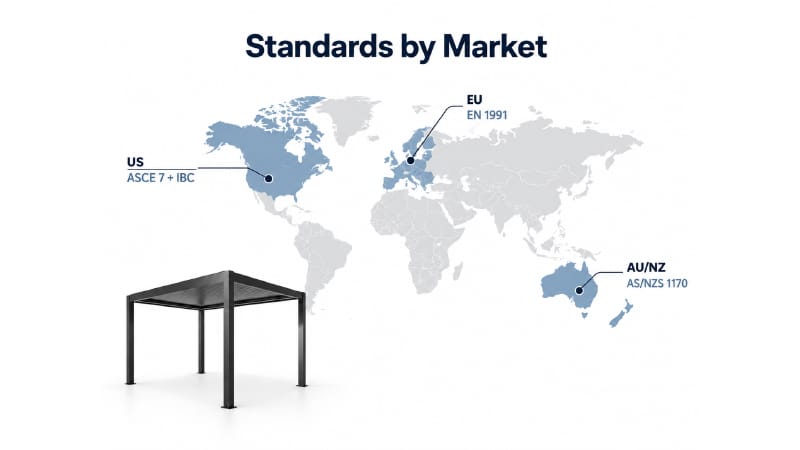
ASCE 7, Minimum Design Loads and Associated Criteria for Buildings and Other Structures, is the US reference for dead, live, wind, and snow loads (ASCE). It defines the load combinations a structure must resist.
The International Building Code adopts ASCE 7 by reference, so compliance with the IBC effectively means meeting ASCE 7 load requirements for the project’s location (ICC). Local amendments set the governing wind speed and ground snow load.
For EU projects, loads follow the Eurocodes, principally EN 1991 (European Commission, Eurocodes). For Australia and New Zealand, AS/NZS 1170 governs actions on structures (Standards Australia). Exporters should hold test evidence mapped to each target market’s standard.
A report carries the most weight when the testing laboratory is accredited to ISO/IEC 17025 for technical competence (ISO 17025), or when the product holds an ICC-ES evaluation report (ICC-ES). For the EU and broader international trade, certificates from bodies such as TÜV or SGS add recognized third-party assurance.
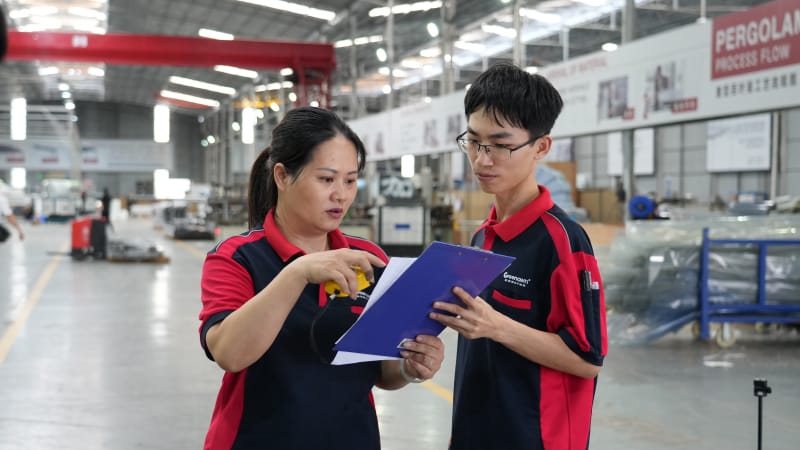
A load test is only as useful as the report that documents it. Knowing what to look for separates a compliant structure from a box of claims.
Missing any of these, the document is weak evidence.
Watch for:
These gaps are common in low-cost sourcing and are exactly what a careful importer should pressure-test.
Before committing to a supplier, work through this checklist:
For a deeper walkthrough, see our guide on how to choose the right aluminum pergola supplier.
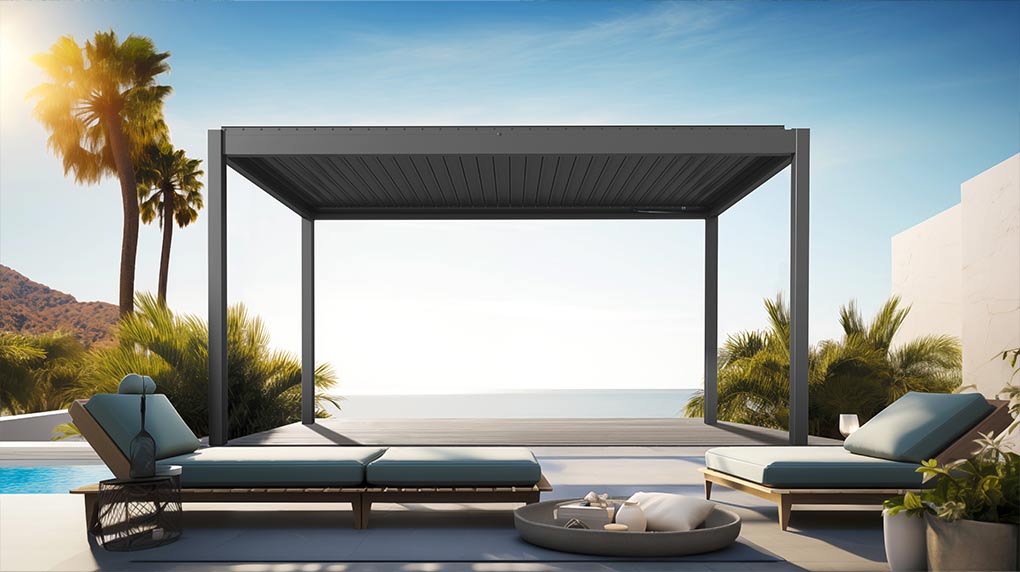
Greenawn is a 29-year aluminum pergola manufacturer with in-house structural validation and partnerships with SGS (SGS-CSTC Standards Technical Services Co., Ltd., Shunde Branch) — an ISO/IEC 17025–accredited testing organization. Our louvered pergola systems are validated by independent third-party testing; for example, model GR9200 was tested by SGS:
Explore our pergola collections for model-specific ratings.
What is the standard load for a pergola? There is no single “standard” number; loads are set by location. In the US, ASCE 7 / IBC define wind and snow loads by site, while live load is referenced from the local code. Always size to the project’s governing values.
Do aluminum pergolas need an engineering stamp? For permanent installations, many jurisdictions require stamped calculations or a test report demonstrating code compliance. Check the local building department; a third-party report smooths the permit path.
How much wind can an aluminum pergola withstand? It depends on the model and testing. Greenawn’s GR9200 louvered pergola was wind-tunnel tested to Beaufort 10 — 55–63 mph (89–102 km/h) with no damage; map this to your site’s ASCE 7 wind speed and exposure category using the project-specific calculation we can provide.
What is the difference between in-house and third-party testing? In-house testing is fast and useful for design validation, but third-party testing by an ISO 17025–accredited lab (or an ICC-ES report) carries independent weight that buyers and authorities trust.
How do I verify an overseas pergola supplier’s test reports? Match the report to the exact model, confirm the lab’s accreditation is current and in scope, check the referenced standard matches your market, and request the measured numbers — not just a pass/fail.
Understanding how aluminum pergolas are tested for structural loads lets contractors specify with confidence and importers source without guesswork. The four load categories — dead, live, wind, and snow — evaluated against ASCE 7, IBC, and, for export, EN 1991 or AS/NZS 1170, turn a marketing claim into engineering evidence. The report you receive, ideally from an ISO 17025–accredited laboratory, is the document that protects your project, your permit, and your reputation.
Ready to specify? Contact Greenawn’s engineering team for the full test report matching your model and market!
Meet Greenawn at the 140th Canton Fair – Oct 23–27, 2026 Greenawn is pleased to announce our participation in the
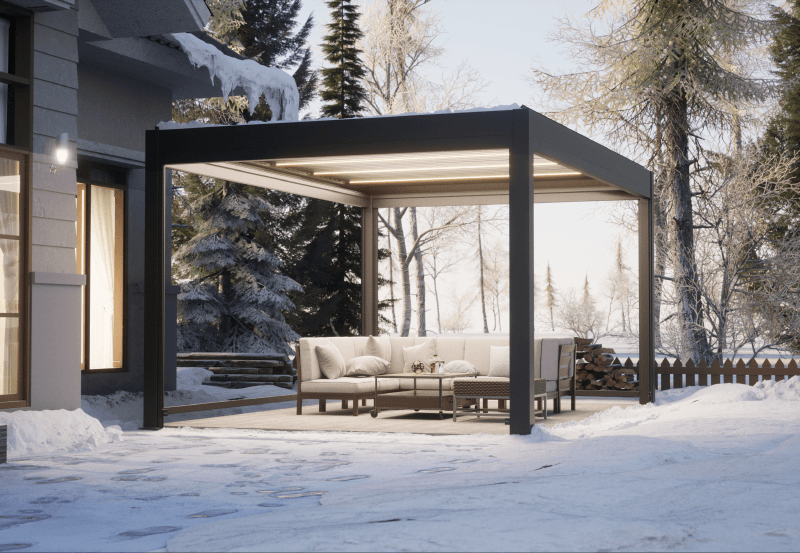
Aluminum Pergola Snow & Wind Load: Engineering Guide A aluminum pergola is typically treated as a permanent outdoor structure for

 Aluminum Pergola CE & EN 1090-1 Compliance Guide
This site uses cookies. By continuing to browse the site, you are agreeing to our use of cookies.
Accept settingsHide notification onlySettingsWe may request cookies to be set on your device. We use cookies to let us know when you visit our websites, how you interact with us, to enrich your user experience, and to customize your relationship with our website.
Click on the different category headings to find out more. You can also change some of your preferences. Note that blocking some types of cookies may impact your experience on our websites and the services we are able to offer.
These cookies are strictly necessary to provide you with services available through our website and to use some of its features.
Because these cookies are strictly necessary to deliver the website, refusing them will have impact how our site functions. You always can block or delete cookies by changing your browser settings and force blocking all cookies on this website. But this will always prompt you to accept/refuse cookies when revisiting our site.
We fully respect if you want to refuse cookies but to avoid asking you again and again kindly allow us to store a cookie for that. You are free to opt out any time or opt in for other cookies to get a better experience. If you refuse cookies we will remove all set cookies in our domain.
We provide you with a list of stored cookies on your computer in our domain so you can check what we stored. Due to security reasons we are not able to show or modify cookies from other domains. You can check these in your browser security settings.
We also use different external services like Google Webfonts, Google Maps, and external Video providers. Since these providers may collect personal data like your IP address we allow you to block them here. Please be aware that this might heavily reduce the functionality and appearance of our site. Changes will take effect once you reload the page.
Google Webfont Settings:
Google Map Settings:
Google reCaptcha Settings:
Vimeo and Youtube video embeds:
Tell us about your pergola requirements. Our team will recommend suitable products and customization options for your market.