Table of Contents
6063-T5 vs 6063-T6 Aluminum: Which Is Better for a Pergola?
If you are comparing aluminum pergolas, you may frequently see two specifications appear repeatedly: 6063-T5 and 6063-T6.
These two popular outdoor‑grade aluminum tempers each have clear pros. There is no single “best” choice for a pergola — so let us examine the characteristics of both materials in detail and compare their suitability for your project.
At First, What Is 6063 Aluminum?
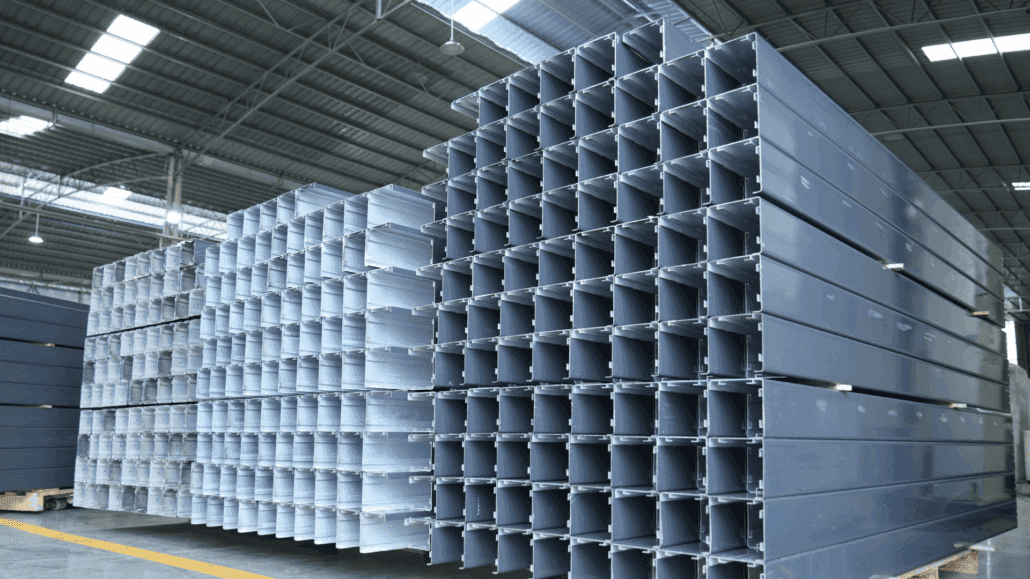
6063 is an aluminum-magnesium-silicon alloy widely used for architectural extrusions.
It offers a useful combination of corrosion resistance, extrudability, dimensional accuracy, surface finish, and mechanical strength. It can also be extruded into relatively complex profiles, which is important for modern pergola systems.
6063-T5 and 6063-T6 share the same basic composition, as both belong to the 6063 aluminum alloy family.
The difference is the temper — the thermal treatment applied to the aluminum after extrusion.
6063-T5 vs 6063-T6: What Is the Actual Difference?
The simplest distinction is the heat-treatment process.
6063-T5
T5 aluminum is cooled after extrusion and then artificially aged.
This produces an architectural extrusion with a useful combination of strength, dimensional stability, machinability, and surface quality.
For this reason, T5 is commonly used where manufacturers need complex or precise extruded profiles rather than simply maximizing the strength of the raw material.
6063-T6
T6 receives more intensive thermal treatment to develop higher mechanical strength.
Compared with T5 of the same alloy, T6 generally provides higher tensile strength, yield strength, hardness.
A simplified comparison looks like this:
| Factor | 6063-T5 | 6063-T6 |
|---|---|---|
| Base alloy | 6063 | 6063 |
| Material strength | Lower | Higher |
| Yield strength | Lower | Higher |
| Elastic modulus | Essentially the same | Essentially the same |
| Corrosion resistance | Excellent | Excellent |
| Architectural extrusion | Widely used | Widely used |
| Complex profile production | Well suited | Possible, but heat-treatment control is more demanding |
| Pergola suitability | Depends on structural design | Depends on structural design |
Is T6 Stronger Than T5?
Yes — But That Is Not the Whole Story.
Here lies a critical distinction: strength is not the same as stiffness.
What is strength vs stiffness?
Strength: How much force the material can withstand before permanent, irreversible bending and damage occurs.
Stiffness: How much the material sags under load, before bouncing back once the load is removed. This property is governed by elastic modulus.
T6 delivers higher yield strength, yet 6063‑T5 and T6 share nearly identical elastic modulus (~69 GPa).
Imagine two beams that are identical in size, wall thickness and internal geometry. The only difference is their temper.
Under normal working loads, both beams will sag by almost the same amount.
Switching to T6 will not boost beam stiffness or reduce elastic sagging.
T6 only raises the yield threshold: more force is required to permanently bend the aluminum.
If you struggle with excessive sag over long spans, you must adjust the beam’s physical design: increase beam depth or wall thickness, add reinforcing ribs, or shorten unsupported spans. Switching to T6 alone will not fix sagging.
Many buyers see “T6” and assume the full pergola is better‑built.
T6 describes a material property — not the performance of the finished structure.
A small, thin T6 beam cannot outperform a well‑engineered, larger‑sized T5 beam.
Why T6 Does Not Automatically Mean a Stronger Pergola
A pergola is a system made from multiple structural members and connections working together.
Several design factors can have a major effect on its final performance.
1. Profile Geometry
Increasing the depth of a structural profile or changing the position of internal ribs can significantly increase its resistance to bending.
This is why two aluminum beams using exactly the same temper may behave very differently.
2. Wall Thickness
“6063-T6” does not tell you whether a beam wall is 1.5 mm, 2 mm, 3 mm, or something else.
Likewise, “6063-T5” does not tell you the amount of aluminum actually used in the structure.
Temper needs to be considered together with the dimensions of the extrusion.
3. Unsupported Span
A beam used across a relatively short module faces different demands from a long-span beam covering a large commercial terrace.
This is why maximum recommended span is often more useful to a buyer than the temper specification alone.
4. Reinforcement
Pergola manufacturers can use internal ribs, reinforced cavities, inserts, or additional structural elements to increase performance in critical areas.
These features cannot be identified simply by looking at the T5 or T6 label.
5. Connection Design
Posts, beams, and louvers do not work independently.
Brackets, fasteners, internal connectors, corner joints, and base plates determine how loads move through the structure.
A high-strength extrusion connected through a poorly designed joint does not automatically produce a high-performance pergola.
6. Anchoring
Wind forces eventually need to be transferred through the frame and into the foundation.
Base plates, anchors, concrete conditions, installation accuracy, and local engineering requirements therefore affect complete-system performance.
This is why comparing pergolas only by aluminum temper can be misleading.
The material matters. The engineering around the material matters too.
Is 6063-T5 Strong Enough for a Pergola?
Yes — when the pergola has been designed around the mechanical properties of 6063-T5 and meets the required structural conditions for the project.
T5 is not limited to decorative trim, louvers, or small residential structures.
A properly designed T5 system can achieve significant structural performance because engineers can design the cross section and complete system around the known mechanical properties of the material.
What Should Buyers Compare Beyond T5 vs T6?
If you are a distributor, contractor, architect, or commercial project buyer, asking about aluminum temper is useful.
Here are the specifications worth comparing:
| Specification | What It Tells You |
| Aluminum alloy and temper | Baseline material properties |
| Beam and post dimensions | Overall size of structural members |
| Wall thickness | Amount of material within the profile |
| Cross-sectional design | How efficiently the profile resists bending |
| Internal reinforcement | Additional support in critical areas |
| Maximum recommended span | Intended structural range |
| Wind resistance | Performance under lateral and uplift forces |
| Roof load capacity | Ability to resist vertical loading |
| Connection system | How loads transfer between components |
| Anchoring requirements | How the structure transfers loads to the foundation |
| Testing / engineering documentation | Evidence supporting performance claims |
Consider a simple example.
Pergola A uses T6 aluminum but has a smaller beam section and relatively thin walls.
Pergola B uses T5 aluminum but has a deeper profile, thicker walls, optimized internal ribs, and reinforced connections.
Which structure is stronger?
There is not enough information to answer.
You would need to compare the complete structural specification and the loads each system is designed to resist.
This is also why phrases such as:
“Made from high-strength 6063-T6 aluminum”
should not be treated as complete proof of pergola performance.
It is a useful material specification — but it is still only one specification.
For serious projects, ask the supplier for information relating to the finished system, including its wind resistance, load capacity, span limits, anchoring requirements, and relevant engineering or test documentation.
T5 vs T6 Should Not Be the Only Buying Decision
So, which is better for a pergola: 6063-T5 or 6063-T6?
If you compare the material alone, T6 is stronger. Its higher yield and tensile strength can provide useful engineering advantages.
But a pergola is not made strong by a temper designation alone.
That means a T6 pergola should not automatically be considered stronger than a T5 pergola from another supplier without comparing the rest of the structural specification.
For buyers comparing pergola manufacturers, the better question is therefore not simply:
“Do you use T5 or T6?”
Ask:
“What is the complete structural specification of the pergola, and what performance is the finished system designed to achieve?”
That answer will tell you far more about the pergola you are actually buying.
If you are still undecided about which material is best for your pergola, contact us today for professional advice and a customized pergola solution!
You may also interested...
OEM/ODM Solutions to Elevate Your Outdoor Brand Value
Ready to take your outdoor product line to the next level? Contact Greenawn. Let us help you elevate your brand with our bespoke solutions tailored for the outdoor industry.
Phone
+86 13622239259
sale2@greenawn.com.cn, sale15@greenawn.com.cn
Find us Here
Building A, No. 13 Bangyan Road, Dalong Street, Panyu District, Guangzhou