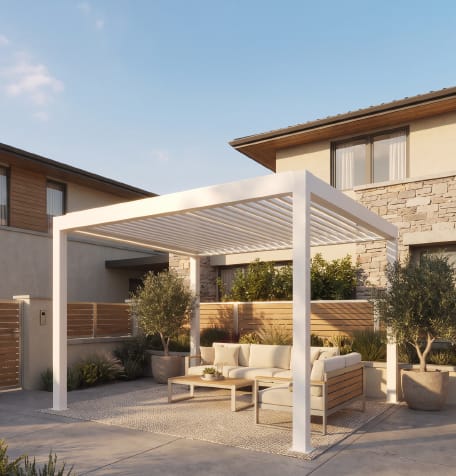

Aluminum Pergola Roof Load Test: How Sandbag Testing Evaluates Structural Strength
How much weight can an aluminum pergola roof withstand?
Structural strength is one of the most important considerations when selecting an aluminum pergola for residential, commercial, and outdoor projects. Beyond the appearance and functionality of the louvered roof, buyers need to understand how the structure performs under additional downward loads.
To evaluate this performance, Greenawn conducted a 3-ton sandbag load test on its GR-9700A motorized louvered pergola. By applying a substantial load across the roof structure, the test demonstrates how the pergola responds to heavy loading conditions and provides a practical reference for evaluating structural performance.
What Is an Aluminum Pergola Roof Load Test?
An aluminum pergola roof load test evaluates how the roof structure responds to vertically applied loads.
For louvered pergolas, the roof system typically includes aluminum louvers, support beams, connecting components, and structural joints. These components work together to distribute loads across the frame and transfer forces to the supporting columns.
Sandbag loading is a practical method of applying controlled weight to the roof. Depending on the test setup, the load can be distributed across the roof or concentrated in designated areas to evaluate different structural responses.
It is particularly useful for observing:
Roof deformation under applied loads.
Beam and louver structural performance.
Connection stability under pressure.
Permanent deformation after unloading.
Greenawn GR-9700A: 3-Ton Sandbag Load Test

To evaluate the structural performance of its motorized louvered pergola, Greenawn conducted a sandbag load test on the GR-9700A.
The test was carried out across a 4 m × 5 m roof area, with sandbags evenly distributed over the entire roof. A total load of 3,000 kg was applied, equivalent to an average load of 150 kg/m².
The load was maintained for 120 minutes to observe the structural response under sustained loading conditions.
Following the test, the GR-9700A showed no obvious visible deformation or structural damage during inspection.
This test provides a practical demonstration of the pergola’s structural performance under the specified loading conditions.
Uniform Sandbag Loading Across the Roof
The sandbags were evenly distributed across the 20 m² roof area to create a uniform downward load.
Uniform loading helps evaluate how the roof structure transfers weight through the louvers, support beams, and connecting components. It also provides a more representative assessment of overall roof performance than loading a single localized area.
120-Minute Sustained Load Test
The total load of 3,000 kg was maintained for 120 minutes.
During this period, the structure was subjected to sustained downward pressure. This loading period allowed the team to observe the roof’s response under the specified test conditions.
After the test, the structure was inspected, with no obvious visible deformation or damage observed.
Structural Performance After Load Removal
After completing the loading test, the GR-9700A was inspected to evaluate its structural condition.
The absence of obvious visible deformation or damage provides a positive indication of the pergola’s performance during this test. For a more comprehensive structural evaluation, measured deflection and residual deformation data can provide additional quantitative evidence.
What Does a 3-Ton Pergola Load Test Demonstrate?

A 3-ton sandbag test provides a practical demonstration of the GR-9700A’s response to a substantial downward load under the specific test conditions.
However, the total applied weight alone does not establish the pergola’s rated load capacity. The actual performance assessment also depends on the roof area, load distribution, loading duration, structural deflection, and post-test inspection results.
For professional project evaluation, buyers should consider the following factors:
Evaluation factor | What to check |
|---|---|
Applied load | Total weight and load per square meter |
Load distribution | Uniform or concentrated loading |
Structural deflection | Maximum measured deformation |
Connection stability | Beam, louver and joint performance |
Residual deformation | Permanent deformation after unloading |
Why Structural Load Testing Matters for B2B Buyers?
For importers, distributors, contractors, and project developers, structural load testing offers additional insight into product quality beyond appearance and material specifications.
It helps buyers evaluate whether a manufacturer’s structural design and production quality are supported by practical testing procedures.
When assessing an aluminum pergola supplier, consider requesting:
Structural load test records.
Aluminum profile specifications.
Roof and beam structural drawings.
Connection and fastening details.
Applicable wind and snow load documentation.
6. Conclusion
Structural performance is an important part of aluminum pergola quality. Through its 3-ton sandbag load test on the GR-9700A, Greenawn demonstrates its focus on structural evaluation and manufacturing quality.
For distributors, importers, and project partners looking for reliable aluminum pergola solutions, understanding how a product is tested is an important step toward making informed purchasing decisions.
Looking for an aluminum pergola manufacturer for your next project? Contact Greenawn to discuss OEM & ODM solutions.
Related Posts
Aluminum Pergola Roof Load Test: How Sandbag Testing Evaluates Structural Strength
Aluminum Pergola Roof Load Test: How Sandbag Testing Evaluates Structural Strength How much weight can an aluminum pergola roof withstand?
Aluminum Pergolas for Coastal Areas: Corrosion, Coatings & Maintenance
Aluminum Pergolas for Coastal Areas:Corrosion, Coatings & Maintenance A pergola three blocks from the ocean looks very different after year