Powder Coating for Aluminum Pergolas: Thickness, Durability & Finish Quality

Powder coating is one of the most widely used finishing methods for aluminum pergolas. It provides a decorative surface, helps protect aluminum profiles against outdoor exposure.
However, not all powder-coated finishes perform equally. Two aluminum pergolas may have the same appearance when delivered, yet develop different levels of fading, chalking, peeling, or corrosion over time.
Our expert guide covers key aspects—such as thickness, durability, and finish quality—to help you select the optimal surface treatment for your outdoor pergola.
What Is Powder Coating on Aluminum Pergolas?
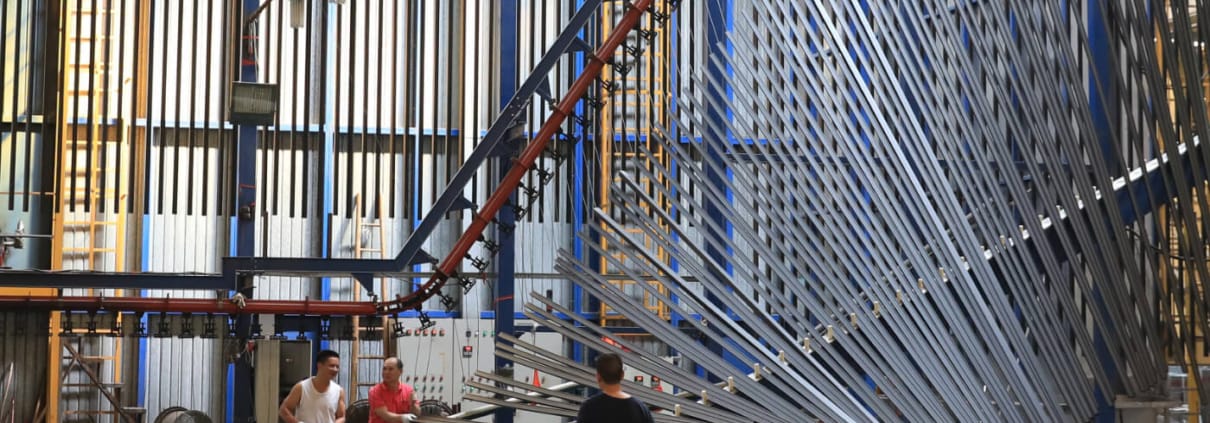
Powder coating is a dry finishing process in which electrostatically charged powder particles are applied to aluminum surfaces. The coated profiles are then heated under controlled conditions, allowing the powder to melt, flow, and form a continuous protective film.
Unlike conventional liquid painting, the powder application process typically does not require solvent-based carriers.
How Thick Should Aluminum Pergola Powder Coating Be?
For architectural aluminum, coating requirements vary according to the applicable standard, coating type, and number of layers.
Powder coating thickness is normally expressed in micrometers (µm). The QUALICOAT specifications provide a useful reference for powder coating used in architectural applications. Many conventional Class 1 and Class 2 single-layer systems specify a minimum coating thickness of 60 µm, while certain two-coat systems have different requirements.
Typical Powder Coating Thickness Requirements
| Coating System | Reference Minimum Thickness |
|---|---|
| QUALICOAT Class 1 Powder Coating | 60 µm |
| QUALICOAT Class 2 Powder Coating | 60 µm |
| QUALICOAT Class 3 Powder Coating | 50 µm |
| QUALICOAT Two-Coat Powder Coating (Classes 1 and 2) | 110 µm |
Reference values from published QUALICOAT specifications. Actual requirements must be checked against the current applicable edition, coating approval, and project specification.
For example, a properly applied 60–80 µm exterior-grade polyester coating may be suitable for many residential applications, provided it meets the relevant performance requirements. A different coating system may require a different film thickness.
Does Thicker Powder Coating Mean Better Durability?
Not necessarily.
A coating that is too thin may provide inadequate coverage, particularly around exposed edges or complex profiles. However, excessive thickness can also create problems when it falls outside the coating manufacturer’s recommended application range.
More importantly, thickness cannot compensate for poor substrate preparation, inadequate curing, or a coating formulation unsuitable for outdoor use.
The better specification is not simply “the thickest coating available,” but a validated coating system applied within its specified thickness range.
What Determines the Durability of Powder-Coated Aluminum Pergolas?

The service performance of an outdoor powder coating depends on several interacting factors. Film thickness is only one of them.
Surface Pretreatment
Before powder application, aluminum profiles must be properly cleaned and prepared.
Depending on the specified finishing system, pretreatment may include degreasing, rinsing, chemical treatment, and the application of a conversion coating or another approved surface preparation method.
This stage helps promote adhesion between the aluminum substrate and the powder coating.
Inadequate pretreatment can contribute to adhesion failures, blistering, and corrosion developing beneath the coating, even when the initial film thickness appears acceptable.
For pergolas installed near coastal areas, enhanced pretreatment is particularly important.
Powder Formulation and UV Resistance
The chemistry of the powder affects how well the finish retains its color and gloss after extended outdoor exposure.
Architectural polyester powders are commonly used for exterior aluminum applications. Higher-weatherability formulations may be selected where strong sunlight and long-term appearance retention are important.
A supplier should therefore identify not only the coating color but also the powder type, manufacturer, and relevant weathering performance classification.
Curing Temperature and Time
After powder application, aluminum profiles are heated to cure the coating.
The powder manufacturer’s specified curing schedule normally defines the required metal temperature and holding time. Simply recording the oven air temperature does not establish that every aluminum profile has reached the necessary curing conditions.
Incorrect curing may affect adhesion, hardness, flexibility, chemical resistance, and overall film performance.
For pergola manufacturers, this is particularly relevant because profiles with different wall thicknesses and cross-sections can heat at different rates.
Installation Environment
A powder coating suitable for a sheltered residential backyard may not be the ideal specification for a pergola installed beside the sea.
Sunlight intensity, airborne salt, industrial pollutants, humidity, and cleaning frequency can all influence finish performance.
For this reason, outdoor coating specifications should be selected according to the intended exposure environment rather than appearance alone.
Powder Coating Standards for Aluminum Pergolas
Several established standards help manufacturers and buyers evaluate architectural aluminum coating performance.
| Standard | Main Purpose | Relevance to Pergola Buyers |
|---|---|---|
| QUALICOAT | Coating materials, processes, testing, and quality assurance | Helps define and verify architectural coating quality |
| AAMA 2603 | Basic organic coating performance | Reference for entry-level architectural finishes |
| AAMA 2604 | High-performance organic coatings | Relevant to more demanding exterior finishes |
| AAMA 2605 | Superior-performing organic coatings | Relevant where enhanced long-term weatherability is specified |
| EN 12206-1 | Powder coating of architectural aluminum | Covers pretreatment, application, and finished-product requirements |
| ISO 2360 | Non-destructive coating thickness measurement | Used to verify dry film thickness on aluminum |
The AAMA 2603, 2604, and 2605 specifications were updated in May 2026. These categories address coating performance, not simply film thickness, and are not interchangeable with QUALICOAT classes.
When reviewing supplier documentation, buyers should distinguish between a coating system designed to meet a standard and a product or process with documented test results demonstrating compliance.
How to Evaluate Powder Coating Finish Quality
A satisfactory powder-coated pergola finish should have consistent coverage, appropriate adhesion, acceptable color variation, and no significant visible surface defects.
Appearance inspection alone, however, cannot establish weathering resistance or coating durability.
Visual Surface Inspection
Inspect major visible components, including pergola posts, beams, louvers, and connecting sections.
Typical defects to check include:
Pinholes, craters, blistering, or exposed substrate
Uneven color or inconsistent gloss
Excessive orange-peel texture outside the approved sample
Scratches or damage caused by handling
Insufficient coverage near edges, corners, or recessed surfaces
Color and gloss should be compared against an agreed reference sample under consistent inspection conditions.
Dry Film Thickness Testing
Coating thickness can be measured using an appropriate non-destructive eddy-current instrument.
ISO 2360:2017 describes this measurement method for non-conductive coatings on non-magnetic, electrically conductive substrates, including powder-coated aluminum.
Amplitude-sensitive eddy-current method
Rather than relying on a single reading, buyers should request measurements from multiple representative locations.
The inspection report should identify the measurement method, sampling locations, acceptance criteria, and recorded results.
Adhesion and Mechanical Performance
Coating adhesion is essential for maintaining film integrity.
Appropriate testing can help identify whether the coating has bonded correctly to the prepared aluminum surface.
Depending on the relevant standard and coating specification, additional testing may assess impact resistance, deformation behavior, and other mechanical properties.
These results provide more useful quality evidence than coating thickness alone.
How to Maintain a Powder-Coated Aluminum Pergola
For residential pergolas, periodic cleaning helps remove dirt, salt deposits, airborne pollutants, and other contaminants.
The basic procedure is straightforward:
Rinse loose dirt from the coated surface with clean water.
Wash using a soft cloth or sponge and a mild, pH-neutral cleaning solution.
Rinse thoroughly to remove cleaning residues.
Inspect exposed edges, connections, and damaged areas.
Arrange suitable repairs when coating damage exposes the aluminum substrate.
Avoid abrasive cleaning pads, strong chemicals, and aggressive cleaning methods that may damage the finish.
Cleaning frequency should reflect local exposure conditions and the coating supplier’s instructions. Coastal pergolas may require more frequent cleaning than those installed in ordinary residential environments.
What Should Buyers Ask an Aluminum Pergola Manufacturer?
When sourcing powder-coated aluminum pergolas, B2B buyers should request technical information that demonstrates both coating performance and manufacturing consistency.
A practical supplier evaluation should cover the following:
| Evaluation Item | What to Request |
|---|---|
| Coating Material | Powder brand, formulation, product reference |
| Film Thickness | Specified range and inspection records |
| Pretreatment | Surface preparation process and specification |
| Weathering Performance | Relevant test reports or performance classifications |
| Adhesion | Applicable test method and results |
| Color Consistency | Approved finish sample and tolerances |
| Production Control | Inspection procedures and batch traceability |
| Coastal Suitability | Enhanced pretreatment and coating requirements where needed |
| Warranty | Coverage, exclusions, and maintenance conditions |
These questions are particularly relevant to OEM and ODM pergola programs, where buyers need consistent finishes across multiple production batches.
A reliable pergola supplier should be able to explain the coating specification, identify the applicable inspection criteria, and provide suitable documentation for the agreed project requirements.
Conclusion
Powder coating plays an important role in the appearance and durability of aluminum pergolas, but finish quality cannot be judged by thickness alone.
For residential pergolas, the combination of proper pretreatment, an appropriate exterior-grade powder, controlled curing, consistent film thickness, and documented quality inspection provides a stronger basis for long-term performance.
For pergola distributors and outdoor living brands, specifying these requirements clearly can help reduce finish inconsistencies and support more reliable product quality.
Greenawn provides OEM/ODM aluminum pergola solutions for residential outdoor living applications. Buyers developing private-label or customized pergola product lines can contact Greenawn to discuss available surface finishes and project-specific coating requirements.
FAQ
What is the recommended powder coating thickness for aluminum pergolas?
Many architectural single-layer powder coating systems use a minimum of 60 µm under QUALICOAT specifications. However, the correct thickness depends on the coating system, applicable standard, and project requirements.
How long does powder coating last on aluminum pergolas?
There is no universal service life. Durability depends on coating chemistry, pretreatment, curing, outdoor exposure, maintenance, and damage.
Is powder-coated aluminum suitable for coastal pergolas?
Yes, provided the finishing system is suitable for coastal exposure. Enhanced pretreatment, appropriate coating performance, careful detailing, and more frequent cleaning may be necessary.
Can powder-coated aluminum pergolas fade in sunlight?
Yes. Color fading and gloss loss can occur after prolonged UV exposure.
Is powder coating better than painting for aluminum pergolas?
Powder coating offers efficient factory application and a wide range of durable exterior finishes. However, high-performance liquid coatings can also provide excellent results.
Related Posts
Aluminum Pergola Powder Coating: Thickness & Durability
Powder Coating for Aluminum Pergolas: Thickness, Durability & Finish Quality Powder coating is one of the most widely used finishing
Freestanding vs Attached Pergola: Which Is Better for Your Project?
Table of Contents Freestanding vs Attached Pergola: Which Is Better for Your Project? Short answer: an attached pergola is usually