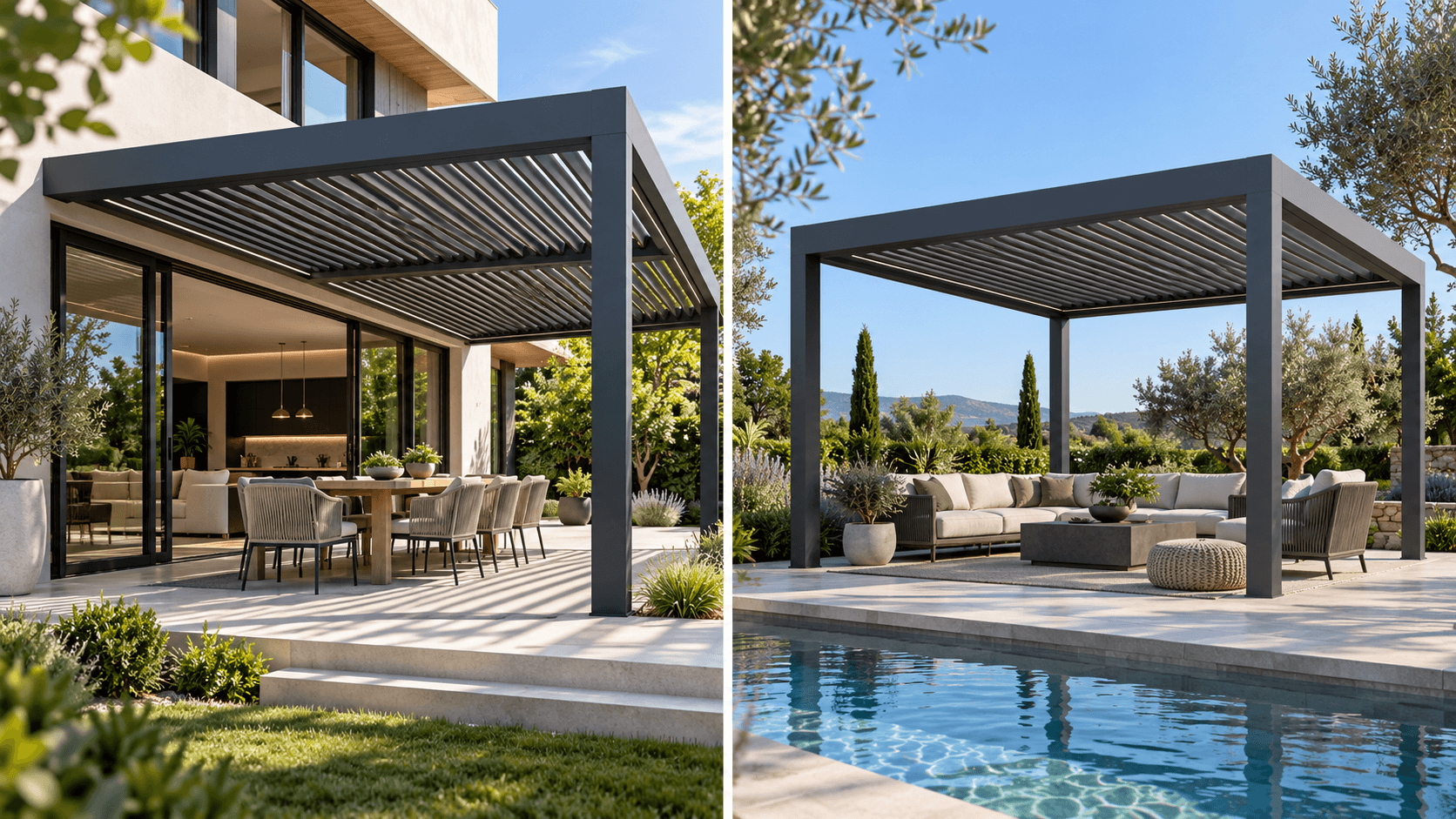
Freestanding vs Attached Pergola: Which Is Better for Your Project?
Table of Contents Freestanding vs Attached Pergola: Which Is Better for Your Project? Short answer: an attached pergola is usually

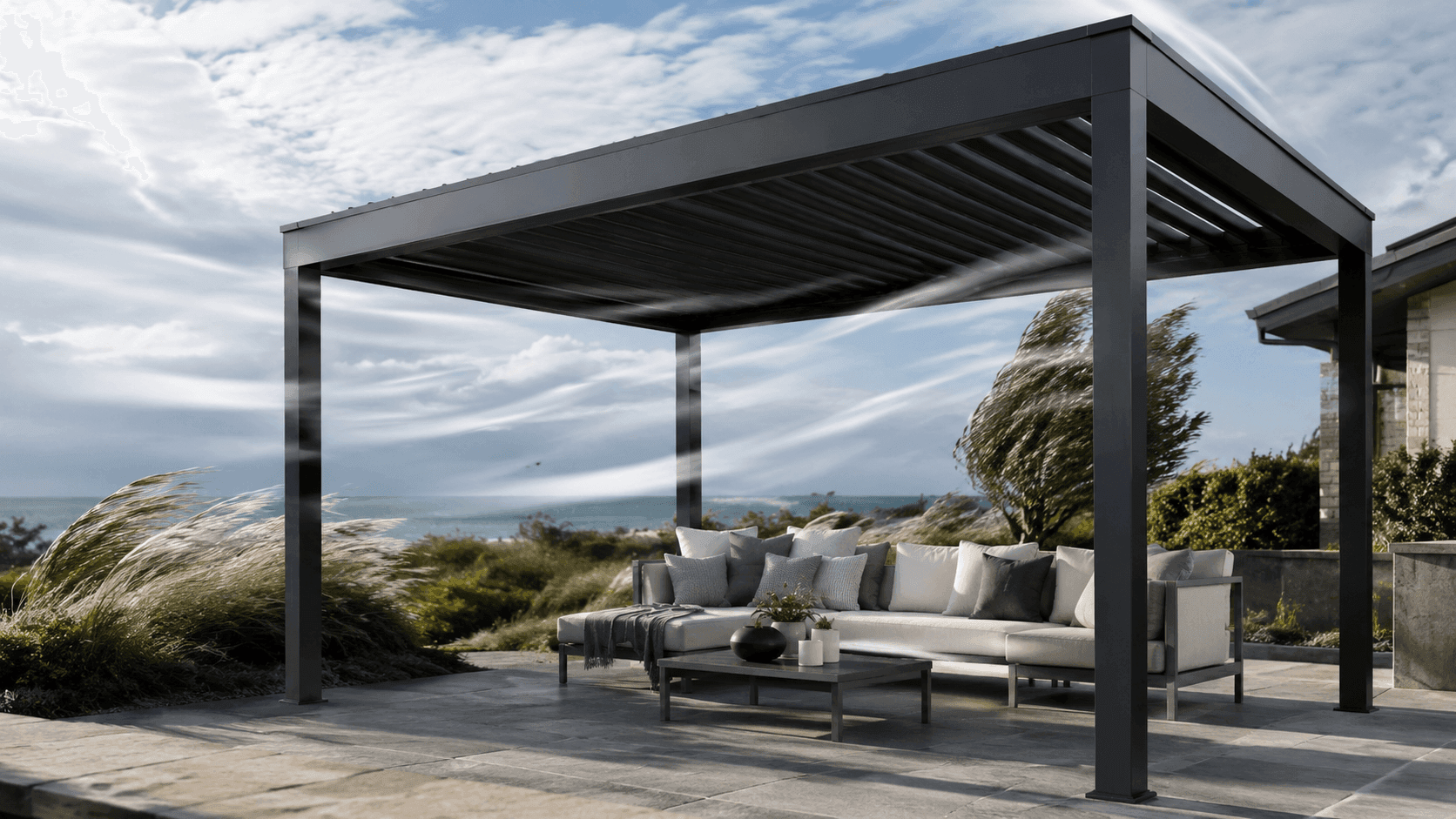
Our customers often ask us: how much wind can a pergola withstand?
A properly anchored aluminum pergola typically handles 80–100 mph (about 20–30 psf) in residential settings.
Commercial louvered pergola reach 120–150 mph (40–55 psf) when the anchoring and site match the calculation. Those numbers mean nothing without the paperwork behind them.
This guide walks you through what wind ratings actually measure, the standards that govern them, and the documents you should demand before specifying a unit on a commercial job.

Louvered roofs feature fundamentally different load‑bearing characteristics from solid roofs, and this constitutes one of their key advantages.
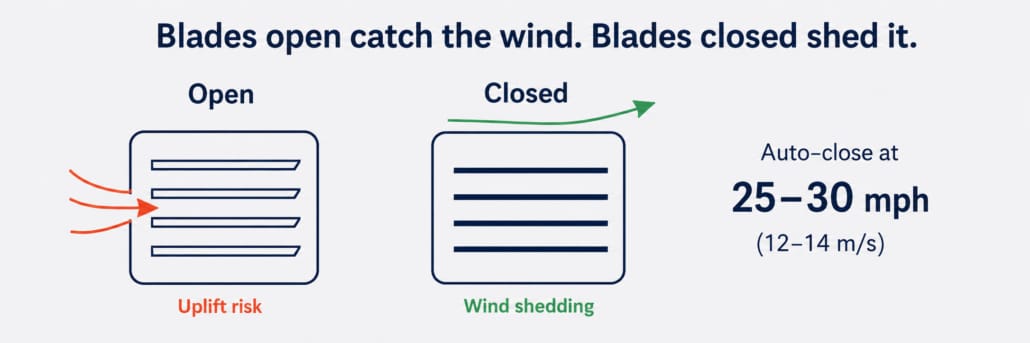
When the louvers are open, air surges upward through blade gaps and generates uplift force on the frame — the most severe loading condition for the structure. Once the louvers are closed, the roof forms a nearly solid surface to dissipate wind force and prevent stress accumulation.
For this reason, commercial louver systems are equipped with dual‑control options: a remote controller for convenient daily operation, and a manual crank as backup. The manual crank enables manual opening and closing of louvers to keep the structure controllable in case of electric system failure or power loss.
For resorts and cafés, this dual‑control configuration is more than a safety feature; it reduces downtime and maintenance demands.
Nevertheless, in hurricane‑prone regions or fully‑exposed coastal sites, no louver system can replace purpose‑built fixed structures engineered to meet local code requirements.
Table of Contents Freestanding vs Attached Pergola: Which Is Better for Your Project? Short answer: an attached pergola is usually

Table of Contents Manual vs Motorized Louvered Pergola: Which Is Better? Choose a motorized louvered pergola if you adjust your

 Aluminum Pergola Shipping Guide: FOB, MOQ & Container Loading
This site uses cookies. By continuing to browse the site, you are agreeing to our use of cookies.
Accept settingsHide notification onlySettingsWe may request cookies to be set on your device. We use cookies to let us know when you visit our websites, how you interact with us, to enrich your user experience, and to customize your relationship with our website.
Click on the different category headings to find out more. You can also change some of your preferences. Note that blocking some types of cookies may impact your experience on our websites and the services we are able to offer.
These cookies are strictly necessary to provide you with services available through our website and to use some of its features.
Because these cookies are strictly necessary to deliver the website, refusing them will have impact how our site functions. You always can block or delete cookies by changing your browser settings and force blocking all cookies on this website. But this will always prompt you to accept/refuse cookies when revisiting our site.
We fully respect if you want to refuse cookies but to avoid asking you again and again kindly allow us to store a cookie for that. You are free to opt out any time or opt in for other cookies to get a better experience. If you refuse cookies we will remove all set cookies in our domain.
We provide you with a list of stored cookies on your computer in our domain so you can check what we stored. Due to security reasons we are not able to show or modify cookies from other domains. You can check these in your browser security settings.
We also use different external services like Google Webfonts, Google Maps, and external Video providers. Since these providers may collect personal data like your IP address we allow you to block them here. Please be aware that this might heavily reduce the functionality and appearance of our site. Changes will take effect once you reload the page.
Google Webfont Settings:
Google Map Settings:
Google reCaptcha Settings:
Vimeo and Youtube video embeds:
Tell us about your pergola requirements. Our team will recommend suitable products and customization options for your market.