
Table of Contents
Are Louvred Pergolas Worth It for Your Business?
Demand for outdoor shade and living structures has continued to grow, creating a favourable market environment for louvred pergolas.
The demand is not purely anecdotal. Houzz’s 2026 U.S. Outdoor Trends Study found that 35% of renovating homeowners were adding shade structures, up 15 percentage points from 2024, while decks remained the most common outdoor structure upgrade at 43%.
The broader outdoor living market is also expanding. Grand View Research estimates that the U.S. outdoor living structure market generated approximately USD 942.9 million in revenue in 2025 and could reach USD 1.41 billion by 2033, representing a projected CAGR of 5.1% from 2026 to 2033. Pergolas and patios were the largest product segment in the U.S. market in 2025.
But a growing market does not automatically make a good business.
If you are considering adding louvred pergolas to your product line, the more important questions are financial and operation.
This guide looks at those questions to help you decide whether selling louvred pergolas makes sense for your business.

Is There Enough Market Demand for Louvred Pergolas?
Before calculating margins or choosing a supplier, there is a more basic question to answer: is there enough underlying demand for the product?
Current outdoor living trends suggest there is a meaningful market.
In the United States, the outdoor living structures market was valued at approximately USD 892.9 million in 2024, with Grand View Research forecasting a CAGR of 5.3% from 2025 to 2030.
Pergolas and patios were the largest product category in the U.S. market, accounting for approximately 63.6% of market revenue in 2024.
For dealers and contractors, however, the important point is not simply that the market is growing. It is why customers are investing in these structures.
Why Residential Customers Are Willing to Buy Pergolas
Outdoor areas are increasingly treated as extensions of the home rather than purely decorative spaces.
NAHB identifies patios, covered outdoor areas, outdoor kitchens and other exterior living spaces as features that can extend the usable living area of a home.
A louvred roof fits particularly well within this trend because it adds something that a conventional open pergola cannot provide: control.
Why Commercial Clients Are Willing to Purchase Pergolas
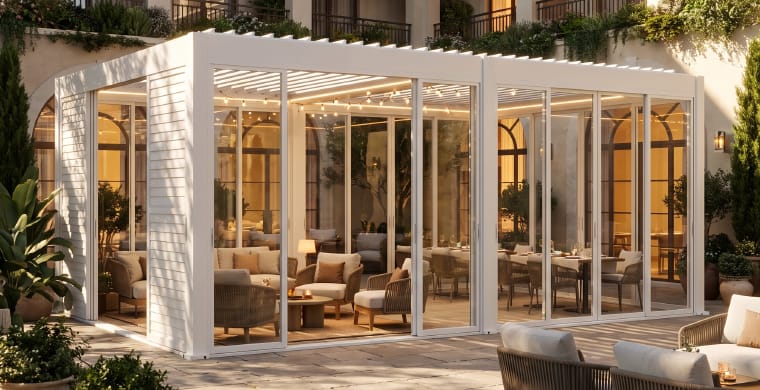
The business case can be even clearer in restaurants, cafés, hotels and resorts.
Toast’s 2025 consumer research found that 48% of respondents were more likely to choose a restaurant with an outdoor dining area, while 62% preferred a covered, screened-in restaurant patio.
That does not mean installing a pergola will automatically increase restaurant revenue by a specific amount.
It does, however, illustrate the commercial value of usable outdoor seating.
For a restaurant or hotel, a weather-protected terrace may help turn an area that can only be used under favourable conditions into space that can operate across a wider range of weather.
This creates a different sales proposition from the residential market.
Residential customers often buy a pergola to improve their lifestyle.
Commercial customers may buy one because the outdoor area itself can contribute to the operation of the business.

Is Your Business a Good Fit for Louvred Pergolas?
Market demand alone does not tell you whether your company should enter the pergola business.
Some companies are much better positioned than others.
Awning and Shading Companies
Awning and shading businesses are among the most natural candidates.
They already serve customers who are actively looking for outdoor comfort solutions.
Installation experience can also reduce one of the biggest barriers to entering the pergola market.
Patio and Outdoor Living Companies
Companies already selling decks, outdoor kitchens, glass enclosures or patio systems can use pergolas as part of a broader outdoor project.
Instead of selling one isolated product, the company can increase the value of an existing project.
For example, a customer building a new deck may also require shade, lighting, weather protection and privacy screens.
Landscape and Construction Contractors
Landscape contractors and builders can also benefit, particularly when pergolas are incorporated into larger garden or property improvement projects.
The main question is whether the business has sufficient installation and technical capability.
A motorized aluminium pergola is not simply outdoor furniture. Larger structures may require careful foundation preparation, accurate measurements, drainage planning and coordination with other building elements.
Existing Pergola Dealers and Distributors
For existing dealers, the decision is usually different.
They may already know that pergolas sell. Their question is whether a new system allows them to improve margins.
When Louvred Pergolas May Not Be a Good Fit
You should be more cautious if your business:
- has no reliable installation capability;
- has limited working capital;
- must purchase substantial inventory before proving demand;
- has no plan for warranty or replacement parts;
- depends entirely on expensive paid advertising for every sale;
- or can only compete by offering the lowest price.
In other words, business fit should come before product selection.
How Much Does It Cost to Add Louvred Pergolas to Your Business?
One of the most common mistakes when assessing a pergola business is looking only at the manufacturer’s unit price.
The real investment can include:
- showroom samples;
- initial inventory;
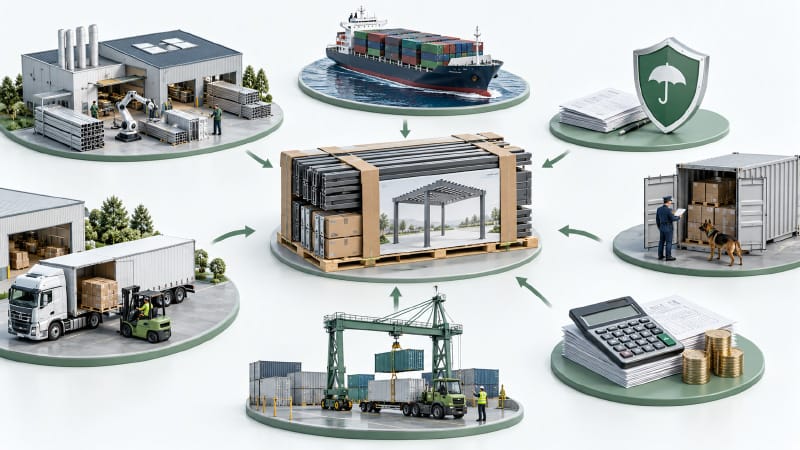
- freight and import costs;
- warehousing;
- website development;
- marketing;
- sales training;
- measuring equipment;
- installation tools;
- staff;
- replacement parts;
- warranty reserves;
- and working capital.
The amount required depends heavily on the business model you choose.
Made-to-Order Model
Under a made-to-order model, the dealer sells the project first and orders the pergola after receiving confirmation or a customer deposit.
Advantages:
- lower inventory risk;
- lower initial capital requirement;
- easier customization.
Disadvantages:
- longer customer lead times;
- greater dependence on supplier production schedules and international logistics.
This model can make sense for new dealers testing a market or businesses focusing on customized projects.
Small Local Inventory
A dealer may instead stock several popular sizes, colours or configurations locally.
This increases the investment requirement but can provide:
- faster delivery;
- easier demonstrations;
- quicker installation scheduling.
The risk is that capital becomes tied up in products that do not sell as quickly as expected.
Showroom Plus Stocked Inventory
A mature dealer may operate a full showroom while holding a broader range of inventory.
This provides the strongest local sales experience and potentially the shortest lead time, but it also creates the highest fixed-cost and inventory exposure.
There is no universally correct model.
The best option depends on local sales volume, expected delivery times, access to capital and how much product customization customers require.
What Margin Can You Actually Make on a Louvred Pergola?
A pergola can appear highly profitable when the selling price is compared only with the factory purchase price.
That calculation can be misleading.
Suppose a pergola project sells for $15,000, while the product itself costs $5,000.
At first glance, the difference looks very attractive.
But the dealer may still need to pay for:
- international and domestic freight;
- duties;
- site measurement;
- installation labour;
- sales commission;
- lead acquisition;
- damaged components;
- warranty claims;
- and after-sales visits.
A more useful number is therefore the contribution margin.
Contribution Margin
Contribution Margin = Project Revenue − Variable Costs Associated With the Project
Consider a simplified example:
| Item | Amount |
|---|---|
| Customer selling price | $15,000 |
| Product + freight | -$6,000 |
| Installation | -$2,500 |
| Marketing + sales | -$1,500 |
| Warranty reserve | -$500 |
| Contribution margin | $4,500 |
The business is not making $9,000 simply because the product and freight cost $6,000.
It is generating approximately $4,500 toward fixed costs and profit.
That leads directly to the next question.
How Many Pergolas Do You Need to Sell to Break Even?
A good product can still become a bad business if the company needs an unrealistic number of sales simply to cover its overhead.
The basic calculation is:
Break-Even Units = Monthly Fixed Costs ÷ Contribution Margin per Project
Suppose your monthly fixed costs are:
$20,000
and the average contribution margin per pergola project is:
$4,000
Your business needs approximately:
5 projects per month
just to reach break-even.
The more important question is not whether five projects are possible during the busiest month of summer.
It is whether the market can support that sales volume consistently enough across the year.
You should therefore work backwards through your sales funnel.
For example:
50 qualified leads → 20 site visits → 12 quotations → 5 sales
If you need five sales per month to break even, you also need a reliable way of generating approximately 50 qualified opportunities under this hypothetical conversion rate.
This is why lead generation and sales conversion matter just as much as product margin.
How Long Will It Take to Recover Your Initial Investment?
Once you know your expected monthly cash flow, you can estimate the payback period.
Payback Period = Initial Investment ÷ Monthly Net Cash Flow
For internal investment planning, a simple framework might be:
- Under 12 months: attractive if assumptions are realistic;
- 12–24 months: potentially reasonable;
- More than 24 months: deserves closer examination;
- More than 36 months: exposes the business to substantially more market and operational uncertainty.
These are not universal industry rules. They are practical thresholds that businesses can adapt according to their own cost of capital and risk tolerance.
More importantly, use net cash flow rather than accounting profit.
A business may report a profit while much of its money remains tied up in:
- inventory;
- deposits paid to suppliers;
- products in transit;
- unfinished installations;
- or customer balances that have not yet been collected.
Can Your Business Handle the Cash-Flow Cycle?
Cash flow deserves particular attention in the pergola business because order values can be substantial and delivery involves several stages.
A typical project might involve:
Quotation → Customer Deposit → Production → Shipping → Installation → Final Payment
Consider two dealers selling exactly the same product.
Dealer A collects a 50% customer deposit before production.
Dealer B collects only 20%.
If both companies need to pay a significant portion of the supplier and freight costs before receiving the final customer payment, Dealer B will require considerably more working capital.
As order volume increases, this difference becomes even more important.
A useful simplified calculation is:
Working Capital Requirement = Inventory + Supplier Payments + Operating Costs − Customer Deposits
This highlights an important principle:
A profitable pergola business can still experience financial pressure if too much cash becomes trapped between order confirmation and final payment.
Paradoxically, rapid growth can make the problem worse.
Ten profitable projects requiring significant upfront cash may create more financial pressure than three projects with healthy deposit terms.
Should You Hold Inventory or Sell Made-to-Order?
Inventory strategy can have a major effect on the economics of a pergola dealership.
Advantages of Holding Inventory
Local inventory can offer:
- shorter lead times;
- quicker installations;
- improved customer confidence;
- easier showroom demonstrations;
- less exposure to international shipping delays.
Risks of Holding Inventory
Inventory also creates:
- capital lock-up;
- storage costs;
- slow-moving sizes;
- unpopular colours;
- obsolete product configurations;
- and potentially damaged stock.
For new dealers, ordering a large range of sizes before local demand has been proven can create unnecessary risk.
A Hybrid Model
For established businesses, a hybrid model may be more practical.
Popular standard sizes and configurations can be stocked locally, while larger or customized projects remain made-to-order.
This is where supplier flexibility starts to affect the financial model.
Factors such as:
- minimum order quantities;
- mixed-container loading;
- custom sizing;
- production lead time;
- packaging efficiency;
- and spare-parts availability
can influence how much inventory a dealer actually needs to carry.
What Are the Biggest Risks of a Louvred Pergola Business?
Before entering the market, do not test the business only under ideal conditions.
Run a downside scenario.
What If Sales Fall by 30%?
If your plan requires 10 projects per month, calculate what happens at seven.
Can the company still cover fixed costs?
If not, how many months can the business operate at that sales level?
What If Product or Freight Costs Rise by 15–20%?
International sourcing introduces another variable.
A project with a comfortable margin can become far less attractive when freight, materials, duties or installation costs increase.
The question is whether those increases can be passed to customers or must be absorbed by the dealer.
What If Customers Pay Late?
Commercial projects in particular can involve longer payment cycles.
A profitable project with a delayed final payment still requires the dealer to pay employees, suppliers and operating expenses.
What If an Installation Goes Wrong?
Installation problems can quickly erase project margins.
Possible issues include:
- incorrect measurements;
- foundation problems;
- drainage errors;
- damaged components;
- motor or electrical problems;
- water leakage;
- or site conditions that were not identified during quotation.
One significant rework can consume the profit generated by several straightforward projects.
What If Warranty Costs Are Higher Than Expected?
Motorized louvred pergolas contain more components than simple fixed patio covers.
Depending on the system, after-sales requirements may involve:
- motors;
- LED lighting;
- control systems;
- louvers;
- seals;
- gutters;
- drainage components;
- hardware;
- and replacement parts.
A warranty reserve should therefore be part of your unit economics rather than treated as an unexpected expense.
What If Competitors Reduce Their Prices?
Standard pergola systems can become highly price-competitive.
Ask yourself a difficult question:
If another dealer offers a visually similar pergola for 15% less, why should the customer still buy from you?
If the only answer is “our product is better,” the competitive advantage may not be strong enough.
Where Does a Profitable Pergola Business Build Its Competitive Advantage?
For dealers, the pergola itself is only part of the business.
More durable competitive advantages often come from the surrounding service.
Local Installation Capability
Customers buying a high-value outdoor structure generally care about whether it will be installed correctly.
A reliable local installation team reduces customer uncertainty and gives the dealer more control over the final result.
Fast Design and Quotation
A company that can measure a site, produce a suitable configuration and return an accurate quotation quickly can outperform competitors selling similar systems.
Reliable Lead Generation
Strong SEO, local search visibility, architect relationships, referrals and established customer channels reduce dependence on paid advertising.
This can materially improve customer acquisition economics.
Commercial Project Experience
Commercial projects are often harder to standardize and therefore harder to compete on price alone.
Experience with:
- restaurants;
- hotels;
- resorts;
- rooftop terraces;
- pool areas;
- and multi-module pergola systems
can help a dealer move toward higher-value projects.
After-Sales Support
Customers are more willing to invest in expensive systems when they know replacement components and technical support will remain available.
Supplier and Engineering Support
Your manufacturer does not create your entire competitive advantage, but it can strengthen—or weaken—many parts of the business.
A supplier’s:
- product consistency;
- customization capability;
- technical documentation;
- engineering support;
- packaging;
- production reliability;
- replacement-parts availability;
- and response to quality issues
all affect the economics of the dealer’s business.
The cheapest unit price does not necessarily produce the lowest total project cost.
Residential or Commercial Pergolas: Which Market Makes More Sense?
Both markets can work, but they involve different economics.
Residential Pergolas
Residential projects generally offer:
- a larger customer pool;
- shorter sales cycles;
- easier standardization;
- more opportunities for smaller installations.
However, they can also involve:
- greater price sensitivity;
- higher dependence on consumer advertising;
- mostly one-time customers;
- more competition from DIY and lower-cost products.
Commercial Pergolas
Commercial projects can provide:
- higher order values;
- multi-module installations;
- larger customized systems;
- repeat B2B relationships;
- opportunities to work with architects, contractors and hospitality groups.
Commercial customers may also evaluate a pergola differently.
For a homeowner, the return is primarily improved comfort and use of the property.
For a restaurant or hospitality operator, the structure may help increase the amount of outdoor space that can be used under changing weather conditions.
The trade-off is greater complexity.
Commercial projects often involve longer sales cycles, stricter technical requirements and more demanding installation coordination.
Companies with strong engineering, installation and project-management capabilities may therefore find the commercial market more defensible than competing exclusively in standardized residential pergolas.
A 10-Question Test Before Investing in Louvred Pergolas
Before adding louvred pergolas to your business, answer these ten questions with actual numbers wherever possible:
- How much cash must you invest before receiving the final customer payment?
- What is your real contribution margin after freight, installation, marketing and warranty costs?
- How many pergolas must you sell each month to break even?
- Can your local market realistically support that sales volume?
- How long will it take to recover your initial investment?
- What happens if sales are 30% below your forecast?
- What happens if product, freight or installation costs rise by 15–20%?
- Can your existing team handle installation and after-sales service?
- What prevents another company from selling a similar system at a lower price?
- If the business does not work, how much of your original investment can you recover?
If several of these questions cannot yet be answered, the next step may not be buying inventory. It may be testing local demand and building a more detailed financial model first.
So, Are Louvred Pergolas Worth It for Your Business?
For the right company, they can be.
The market data shows that pergolas and outdoor shade structures are part of a substantial and growing outdoor living category. Consumer interest in shade structures has also increased, while commercial outdoor spaces continue to have clear value for hospitality businesses.
But market growth should only be the beginning of the decision.
Louvred pergolas are more likely to make sense if:
- you already serve outdoor living or shading customers;
- your break-even sales volume is achievable;
- project margins remain healthy after all variable costs;
- customer deposits reduce working-capital pressure;
- you have reliable installation and after-sales capabilities;
- you can differentiate through service, projects or local expertise rather than price alone;
- and your supplier can support consistent quality, technical requirements and future replacement parts.
You should be more cautious if entering the market requires substantial inventory before demand is proven, if margins depend on unrealistically low installation or marketing costs, or if the entire business model relies on selling standardized products more cheaply than competitors.
Ultimately:
Market growth tells you there is an opportunity. Your margins, cash flow, operational capability and competitive advantage determine whether that opportunity is worth pursuing.
Evaluate the Business Model Before Choosing a Pergola Supplier
If you are considering louvred pergolas as a new product line, comparing factory prices is only one part of the decision.
Production lead times, packaging and container utilization, customization, technical documentation, spare-parts availability, quality consistency and project support can all affect the true cost of operating the business.
Greenawn works with pergola dealers, outdoor living companies, contractors and project partners on standardized and customized aluminium louvred pergola systems for residential and commercial applications.
When evaluating a supplier, look beyond the price of the pergola itself and consider how the manufacturing relationship will affect your inventory, installation efficiency, project risk and long-term profitability.
You may also interested...

OEM/ODM Solutions to Elevate Your Outdoor Brand Value
Ready to take your outdoor product line to the next level? Contact Greenawn. Let us help you elevate your brand with our bespoke solutions tailored for the outdoor industry.
Phone
+86 13622239259
sale2@greenawn.com.cn, sale15@greenawn.com.cn
Find us Here
Building A, No. 13 Bangyan Road, Dalong Street, Panyu District, Guangzhou