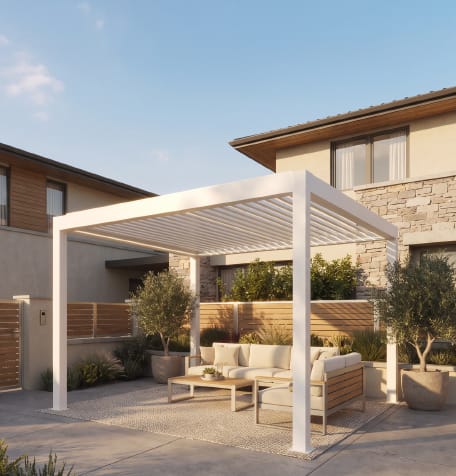
What are the Benefits of adjustable aluminum pergola?
February 4, 2026
As an experienced pergola manufacturer, we have found that when customers inquire about pergolas, they rarely ask, “Does it look good?” It’s usually “how many hours a day can I actually use this space.” A patio, pool deck, or restaurant terrace can have great bones and still sit empty half the year.
How to extend the time spent on outdoor activities? That’s the real value of an adjustable aluminum pergola.
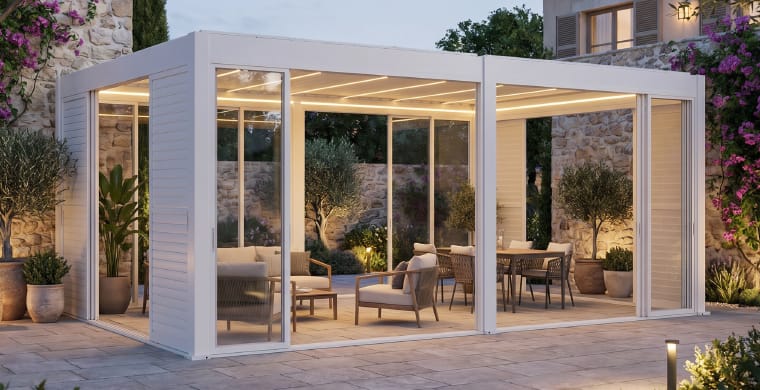

What do customers want when they ask for a pergola?
Across residential and commercial projects, we found what the customers really want is:
- Shade that adjusts instead of staying fixed all day
- Airflow that doesn’t disappear the moment you add a roof
- A proper drainage path for rain, not just a roof that “blocks” it
- More usable hours in the same outdoor footprint
- Some protection for furniture and fixtures from sun and rain
- Lower long-term maintenance than wood or untreated steel
- Add-ons like lighting, side screens, or sensors when needed
- Enough structural range to work for both homes and commercial sites
The difference from a fixed roof isn’t just “more shade” — it’s that the structure can respond to changing conditions instead of locking the space into one state all day.
8 Practical Benefits of Adjustable Aluminum Pergola
Adjustable Sun and Shade
This is the most direct benefit of a louvered roof: how much sunlight actually reaches the space underneath.
Fully open louvers let in the most light and keep the area feeling open — no one likes being in an environment that feels oppressive and cramped.
Tilted louvers are, in our experience, the setting most people end up using day to day. They cut direct glare without putting the whole area in constant shadow, which a solid fixed roof simply can’t do — it’s either shaded or it isn’t.
Fully closed louvers give the strongest shade and weather coverage, typically reserved for peak sun or incoming rain. For residential patios, pool areas, restaurant seating, and hotel lounges, being able to move between these three states matters more than the shade percentage on a spec sheet.
Better Ventilation in Hot Weather
Shade alone doesn’t guarantee comfort. In hot climates, a fully sealed roof can trap warm air underneath even when there’s no direct sun — the space still feels stuffy.
When the louvers are open or tilted — that position lets warm air escape through the gaps while shading the space at the same time, and it keeps the surrounding air moving rather than sitting still under a solid cover.
It’s not a substitute for air conditioning or mechanical ventilation, but for open-air spaces that get regular use — home patios, outdoor restaurants, pool lounges, hotel terraces, resort common areas — pairing shade with airflow generally performs better than shade alone.
More Practical Rain Management
A basic open pergola usually adds shape and some shade, but it isn’t built to handle real rainfall. A well-engineered adjustable louvered pergola, once closed, channels roof water into an integrated drainage system rather than just deflecting it.
A typical drainage path looks like this:
Louvers → beam gutter → drainage channel → posts → ground drainage point
So during rain, the roof isn’t “keeping water out” on its own — the full roof and drainage assembly is doing the work.
One thing worth being honest about: an adjustable pergola is not a sealed indoor roof. How well it actually performs in rain depends on the louver overlap design, gutter capacity, post drainage, installation accuracy, site slope, rainfall intensity, and wind direction. Because these are open structures, strong wind can still push rain in sideways even with the roof fully closed.
If you’re planning a project in a rainy region, it’s worth evaluating the full drainage system rather than assuming a closed roof alone will keep the space dry.
Use Your Outdoor Space for More Hours
A fixed roof only has one setting. An adjustable one can shift along with the sun through the day — open in the morning for light, tilted at midday to cut direct glare, left slightly open in the hot afternoon for airflow, adjusted again as the sun drops in the evening, and closed if light rain moves in.
That means the same patio can support breakfast, a midday break, a family dinner, or hosting guests, without switching locations. For restaurants, hotels, and resorts, that flexibility can directly affect how many hours their outdoor seating actually gets used rather than sitting empty.
Protect Outdoor Furniture
Sun exposure and repeated rain are two of the biggest reasons outdoor furniture, cushions, and equipment wear out early.
An adjustable pergola won’t fully isolate furniture from the weather, but controlling overhead sun and rain does reduce how much direct UV and moisture exposure furniture gets over time — particularly with the louvers closed. That includes outdoor sofas, dining sets, cushions, grill stations, and other fixtures underneath.
That said, if the site is coastal, high-wind, or gets frequent storms, a roof alone isn’t enough — side screens, storage solutions, and furniture rated for outdoor weather still need to be part of the plan.
Lower Maintenance With Aluminum
Aluminum is one of the most common structural materials in modern pergolas for good reason. Unlike wood, it doesn’t rot or attract insects, and it doesn’t need periodic staining or sealing. Compared to untreated or poorly coated steel, aluminum also resists corrosion better. Higher-quality aluminum pergolas are usually finished with outdoor powder coating for additional weather resistance.
Routine pergola maintenance is mostly clearing leaves, dust, and debris from the louvers and gutters, checking that drainage channels aren’t blocked, and inspecting moving parts or motorized components per the manufacturer’s guidance.
It’s worth being clear that low maintenance isn’t the same as no maintenance. A motorized louvered pergola has motors, drive mechanisms, control systems, and moving joints — more components to check periodically than a fixed roof has.
More Ways to Use the Same Space
Arguably the biggest practical benefit is turning one fixed outdoor footprint into several different functions. A residential patio can move from a breakfast spot to a midday rest area to a family dinner setting to an evening gathering space — all without adding square footage.
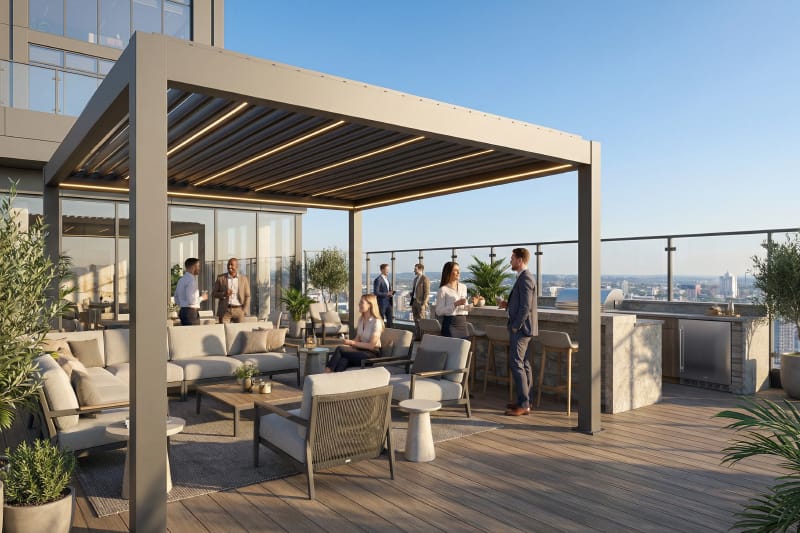
For restaurants and hotels, the same logic applies to outdoor seating, which can be adjusted based on weather and time of day. This is a large part of why adjustable louvered pergolas show up so often in villa gardens, poolside areas, rooftop terraces, restaurants, hotels, resorts, and larger commercial outdoor spaces — they adapt to more scenarios than a fixed shade structure would.
Manual, Motorized and Custom Options
Manual louvered pergolas are structurally simpler and don’t need power or a control system. They tend to suit smaller residential projects, spaces that aren’t adjusted often, or sites where wiring is limited.
Motorized louvered pergolas can be adjusted with a remote, wall switch, or app, and often support further additions — LED lighting, side screens, weather sensors, and compatible smart control features. For hotels, restaurants, or homes that adjust the roof frequently, motorized systems are usually more convenient day to day. Exact automation capability still depends on the specific product and control system, so it’s worth confirming before assuming a feature is included.
Beyond open/close mechanics, most adjustable aluminum pergolas can also be customized on structure size, color, louver style, freestanding or wall-mounted installation, lighting, side curtains, sliding glass, and decorative panels. For commercial projects especially, this matters — restaurants, hotels, and resorts usually need to balance architectural style, seating layout, circulation space, brand colors, local climate, and structural load all at once. At that point, a well-built louvered pergola project starts to look less like patio furniture and more like a small building system.
What Should You Check Before Buying?
It’s easy to compare pergolas on looks and price alone. What actually determines whether a project performs well long-term is closer to engineering than aesthetics.
Structure size and span — confirm the maximum span, beam dimensions, and post layout match the site.
Roof mechanism — check how the louvers open, their rotation range, whether the system is manual or motorized, and how it’s controlled.
Drainage system — understand how the gutters, beams, and posts move water out, and check that against local rainfall.
Wind and snow load — coastal sites, high-wind areas, and regions with heavy snowfall need specific structural engineering, not a generic spec sheet.
Installation type — confirm whether the site suits freestanding or wall-mounted installation, and whether the foundation or wall can support it.
Accessory compatibility — if zip blinds, LED lighting, glass, heating, or automation are planned for later, it’s worth designing for them upfront rather than retrofitting.
Conclusion
The benefits of adjustable aluminum pergola in your backyard or on your patio are obvious. When the heat on the patio becomes unbearable for extended periods, a pergola provides welcome coolness. However, finding the right pergola is also crucial.
Greenawn designs and manufactures aluminum louvered pergola systems for residential, hotel, restaurant, and commercial outdoor projects, with options for size, color, structural requirements, and accessories. If your project needs adjustable shade, integrated drainage, motorized control, side systems, or OEM/ODM customization, our team can help match a configuration to your site conditions.