Can You Put an Outdoor Kitchen Under a Pergola?
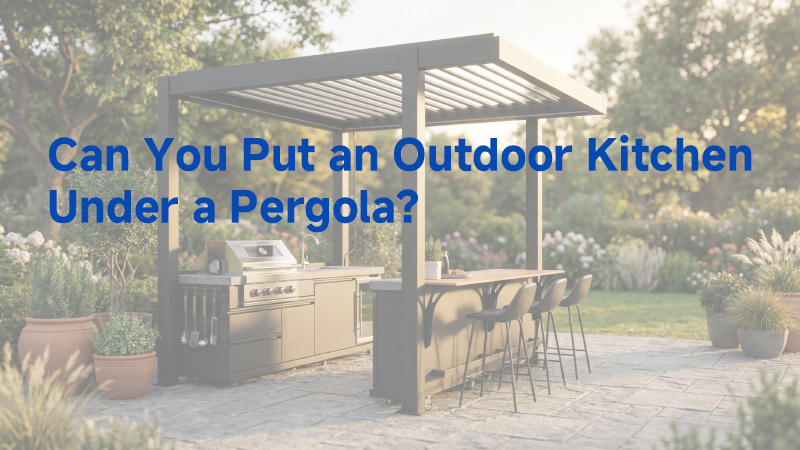
Can an outdoor kitchen be installed under a pergola? The answer is yes, but only when the structure is properly engineered with suitable materials, ventilation planning, and commercial-grade safety considerations.
For contractors, importers, and commercial outdoor project developers, this is not a simple design choice. It directly affects fire safety performance, long-term durability, maintenance cost, and user experience in hospitality or residential-commercial hybrid projects.
In modern outdoor living and commercial landscape projects, the combination of a pergola and outdoor kitchen has become a standard solution. However, success depends heavily on selecting the right pergola system and installation strategy.
Is a Pergola Right for an Outdoor Kitchen?
The short answer is yes — when the structure is built for it. In commercial projects like resort dining areas, rooftop restaurants, and private estates, a well-engineered pergola creates a defined cooking and dining zone that improves spatial efficiency. It costs less than a permanent indoor extension and gives you more flexibility on layout and scale. The key is choosing the right system from the start.
What Goes Wrong When It’s Poorly Designed
A pergola that wasn’t built for cooking becomes a liability fast. Heat accumulates, grease coats structural surfaces, and smoke has nowhere to go. Wood pergolas near open flames are a fire risk. Corrosion from steam and oil shortens the lifespan of any structure not rated for kitchen use. For contractors, these failures show up as safety non-compliance and expensive callbacks.
The Right Pergola for an Outdoor Kitchen
Aluminum Louvered Pergolas — The Recommended Solution
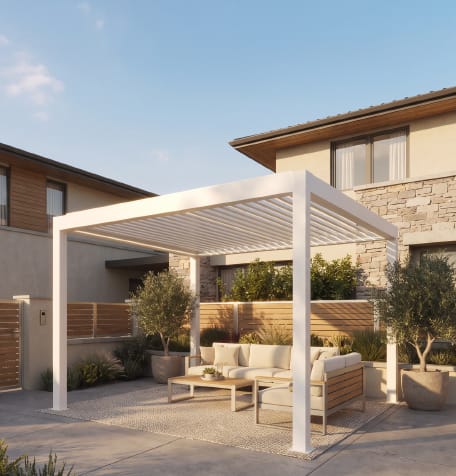
Aluminum louvered pergolas are the best fit for professional outdoor kitchen environments. Adjustable louvers let you control airflow, release smoke, and manage sunlight without permanently opening or closing the space. Greenawn‘s commercial-grade systems use high-strength 6063-T5 aluminum profiles, integrated drainage channels, and hidden wiring for lighting and automation. They’re built to perform in high-frequency commercial use — not just weekend grilling.This perfectly solves the problems caused by the aforementioned design flaws.
Why Wood Pergolas Don’t Belong Near Commercial Kitchens
Wood absorbs grease, cracks in humid or coastal conditions, and poses a genuine fire risk near open flames. Even in low-budget residential builds, the long-term maintenance costs add up quickly. Aluminum pergolas are non-combustible, require minimal upkeep, and carry a 20–30+ year service lifespan. For any commercial project, the choice is straightforward.
Structural Standards That Matter
Commercial pergolas used in cooking environments need to meet real engineering standards. Greenawn systems are rated for wind resistance up to 120 km/h, feature fully integrated waterproof louver drainage, and use UV-resistant powder coating for long-term outdoor exposure. Sealed beam construction prevents grease infiltration into the structure itself.
Design and Installation: What to Get Right
Dimensions and Clearance
Plan for a minimum height clearance of 2.6 to 3.2 meters, depending on your equipment. Safe spacing between cooking units should run 80 to 120 cm. Commercial projects typically need oversized layouts to ensure proper heat dispersion and flexible equipment placement — undersizing is one of the most common and costly mistakes.
Ventilation and Heat Management
Ventilation is the single most critical factor in outdoor kitchen pergola design. Adjustable louvers handle natural smoke release, but open-sided configurations and mechanical exhaust integration make a real difference in high-volume environments. Avoid fully enclosed structures in BBQ areas. Without proper airflow, grease buildup and heat concentration shorten the lifespan of both the pergola and the kitchen equipment beneath it.
Material Selection for Long-Term Performance
The materials you choose determine how the structure performs five and ten years out. Greenawn uses 6063-T5 aluminum alloy profiles, powder-coated surfaces, 304/316 grade stainless steel fasteners, and UV-resistant sealing components. These hold up against heat, humidity, grease, and coastal corrosion — the four conditions that destroy inferior systems.
Drainage Design
Drainage is often an afterthought, and it causes real problems when neglected. Sloped flooring, integrated gutter systems inside pergola beams, and separate grease and rainwater drainage paths are all standard in a properly designed system. Add non-slip, commercial-grade flooring and you’ve covered the hygiene and safety bases too.
Common Questions
1.Does an outdoor kitchen need a fully enclosed pergola?
In most commercial applications, fully enclosed structures are the wrong call. Semi-open or louver-adjustable systems provide better ventilation, heat control, and safety performance. Enclosure works against you in a cooking environment.
2.Can a motorized pergola handle heat and smoke from grilling?
Yes — when it’s properly designed. Aluminum motorized pergolas are engineered for outdoor environments, including active cooking areas. Proper ventilation design and safe clearance from direct flames are non-negotiable.
3.What size pergola works for a commercial outdoor kitchen?
Typical configurations run 3m × 4m for small commercial setups, 4m × 6m for mid-size restaurant patios, and modular systems above 6m × 10m for large hospitality projects. Final sizing depends on your equipment layout and service volume.
Get a Tailored Engineering Spec from Greenawn
Tell us about your project and we’ll send a custom engineering spec and commercial quote — usually within 24 hours.
With nearly 30 years of manufacturing experience in aluminum outdoor shading systems, Greenawn supports contractors, importers, and project developers with custom sizing solutions, project-based technical support, and bulk OEM/ODM production for commercial orders. We know what commercial outdoor kitchens demand — and we build pergola systems that meet that standard.