
Can pergola used as carport?
May 12, 2026
Many people often ask, “Can pergolas be used as carports?” The answer is absolutely yes! Modern pergolas are not only designed to provide shade but can also serve as practical and reliable carports. With the right design, materials, and installation, pergolas can offer the same protection as traditional carports while adding aesthetic value and flexibility.
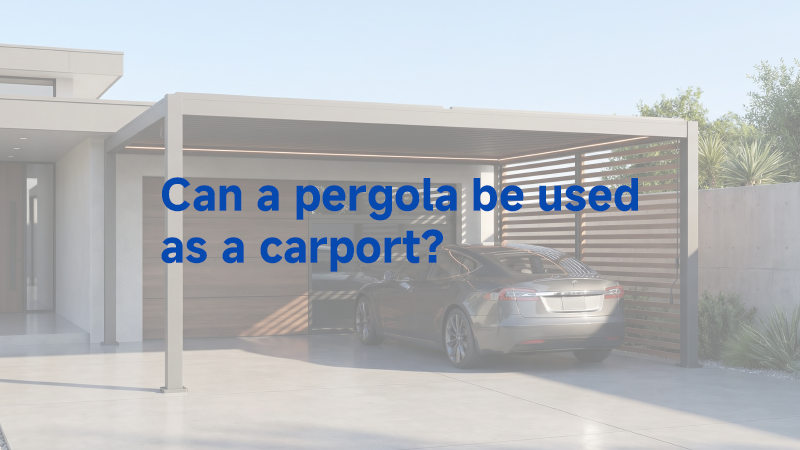
What Is a Traditional Carport?
Traditional carports have a simple structure, consisting only of supporting columns and a roof. Unlike the fully enclosed garages we commonly see, they offer basic protection, but only at a basic level.
Compared to modern carports, traditional carports prioritize practical parking protection, with less emphasis on decorative and multifunctional design.
Pergola Carport or Traditional Carport?
So, what are the differences between the modern carport and the traditional one? When comparing pergolas to traditional carports, several advantages become clear:
- Flexible Design– Pergolas offer modern, sleek designs that can be customized to match the surroundings. Unlike traditional carports, they provide aesthetic value in addition to functional coverage.
- Efficient Drainage– Many pergolas include hidden drainage systems that channel rainwater away from vehicles, preventing water accumulation and potential damage.
- Durability– Made from high-quality materials like powder-coated aluminum, pergolas are highly resistant to corrosion, UV rays, and heavy loads, ensuring long-lasting performance.
- Easy Installation– Modular construction enables quick assembly and expansion, reducing installation time and labor costs compared to traditional carports.
In summary, pergolas combine both beauty and practicality, making them a modern and efficient alternative to conventional carports.
How Can a Pergola Be Used as a Carport?
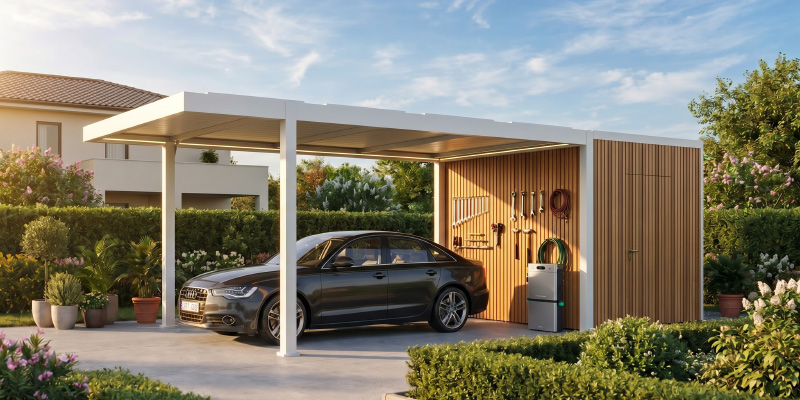
Just need simple structure matching and proper installation, a standard pergola can easily double as a functional carport.
With its robust aluminum frame, sturdy roof panel, and stable pillar support, this canopy provides all-around shelter for your vehicle, protecting it like a dedicated carport. For even better protection, you can add ZipBlind.
Its open-sided design keeps the space well-ventilated, avoiding the stuffiness of enclosed garages. You can also adjust the size, height and layout to perfectly fit different vehicle sizes.
The Benefits of Using a Pergola as a Carport
Using pergolas as carports brings multiple benefits, especially for B2B clients seeking durable and customizable solutions:
- Vehicle Protection– Pergolas shield cars from sun, rain, snow, and debris, preserving vehicle quality and reducing maintenance needs.
- Flexible Applications– Suitable for commercial parking lots, residential driveways, hotels, and other outdoor spaces. Pergolas can be scaled to meet different project requirements.
- Low Maintenance– High-quality materials and precision engineering minimize upkeep, making pergolas a cost-effective option for long-term use.
- Customizable Design– From size and layout to color and style, pergolas can be tailored to reflect a company’s brand identity or specific client needs.
- Enhanced Visual Appeal– Sleek, modern pergolas improve the aesthetics of any outdoor area, elevating the overall impression of commercial or residential spaces.
These advantages make pergolas a compelling choice for developers, property managers, and businesses seeking functional and attractive parking solutions.
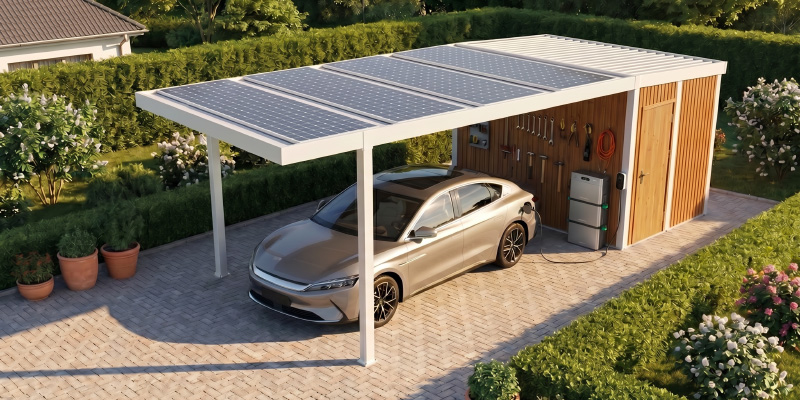
Aluminum vs. Wood Pergolas for Carports
Choosing the right material is crucial for using a pergola as a carport. Common choices include aluminum, wood, and PVC pergolas. Here, we’ll focus on comparing aluminum and wood pergolas.
- Aluminum Pergolas– Lightweight, corrosion-resistant, low-maintenance, and highly durable. Aluminum structures can withstand extreme weather and require minimal upkeep, making them ideal for commercial applications or high-traffic areas. They are also easy to customize in color, size, and design.
- Wood Pergolas– Offer a natural and warm aesthetic. While strong, wood requires regular maintenance such as sealing, staining, and protection against insects and moisture. Wood pergolas are better suited for high-end residential applications rather than commercial parking.
For B2B projects, aluminum pergolas are generally the preferred choice due to durability, long-term cost savings, and professional appearance.
Greenawn’s new collection
At Greenawn, we are proud to introduce our latest pergola carport series, designed specifically with B2B clients in mind. Our products are fully OEM/ODM ready, allowing businesses to customize to meet your unique project requirements.
Built with precision and using durable materials, our pergola carports are engineered for long-term reliability. Modular design ensures straightforward installation, while sleek, professional aesthetics enhance the visual appeal of parking areas, hotels, residential complexes, and commercial properties.
With nearly 30 years of manufacturing experience and a 30,000-square-meter state-of-the-art factory, Greenawn is capable of delivering high-quality, large-scale solutions for international clients. Our team supports every stage of the project, from design consultation to installation guidance, ensuring seamless delivery and peace of mind for our customers.
Whether you are looking to provide additional parking protection, improve the visual appeal of your outdoor areas, or offer a customizable pergola solution for clients, our new series provides the ideal balance of functionality, durability, and design.
Conclusion
Pergolas are a versatile, durable, and visually appealing alternative to traditional carports. They provide vehicle protection, low maintenance, customizable designs, and professional-grade aesthetics suitable for a wide range of B2B projects.
As an experienced OEM/ODM supplier, Greenawn offers tailored pergola carports designed to meet exact client specifications. Contact us if you have any requirements!
FAQ
1. Are pergolas suitable for commercial carport projects?
Yes. Greenawn pergolas are engineered for high-traffic commercial and residential projects, offering robust structural performance, modular design, and customizable dimensions.
2. Can pergolas be customized to fit specific site requirements?
Absolutely! Greenawn provides full OEM/ODM solutions to match project specifications and client branding.
3. Do pergolas meet building regulations and safety standards for commercial use?
Yes. Greenawn pergolas can be designed to comply with local building codes, wind and snow load requirements, and international standards.


Louvered Pergola vs Fixed Roof: Which Is Better?
blogTable of Contents
Louvered Pergola vs Fixed Roof: Which Is Better?
The 30-second answer
A louvered pergola gives you a roof you can open and close. A fixed roof gives you permanent, always-on cover. If the goal is to switch between open sky and full shade — or to control light, rain, and ventilation precisely — the louvered pergola is the right call. If the goal is simple, lower-cost, always-on protection that you never plan to adjust, a fixed roof is the honest answer. Many premium projects use both, in different zones.
Choosing between a louvered pergola and a fixed roof comes down to one question: do you want permanent shelter or adjustable control?
A fixed roof provides consistent coverage, while a louvered pergola lets you control sunlight, shade, airflow, and rain protection.
This guide compares their cost, durability, weather performance, and best-use scenarios — including when combining both makes more sense.
Quick Comparison Table
What Is the Main Difference Between a Louvered Pergola and a Fixed Roof?
The biggest difference between a louvered pergola and a fixed roof is adjustability.
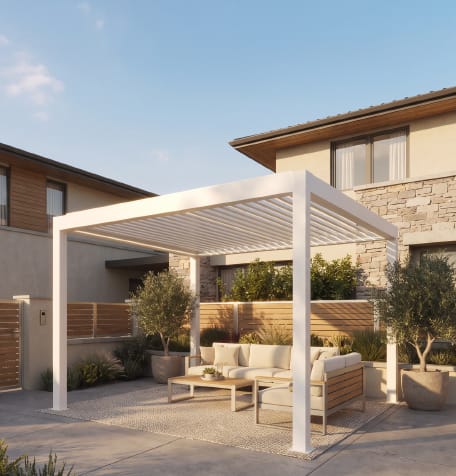
A louvered pergola uses rotating roof blades that can be opened, tilted, or closed depending on how much sunlight, shade, ventilation, or rain protection you want.
A fixed roof stays permanently covered. Once installed, it provides continuous shade and shelter but cannot be opened to bring sunlight or airflow back into the space.
Neither option is inherently better.
If you want an outdoor area that can switch between open and sheltered conditions, a louvered pergola offers more flexibility.
If you want the area permanently covered with no need for adjustment, a fixed roof may be the simpler solution.
Which Costs More: a Louvered Pergola or a Fixed Roof?
A fixed roof is generally simpler and therefore tends to have a lower upfront cost than a comparable louvered pergola.
A louvered pergola costs more because the roof must both move and manage weather when closed. Depending on the model, this may require additional structural components, integrated drainage, motors, controls, and other accessories.
However, price alone does not determine value.
A fixed roof may be the better investment if the area only needs permanent shelter.
A louvered pergola may justify the higher cost when the ability to control sunlight, ventilation, shade, and weather protection will actually be used.
The final project cost of either system also depends on size, material, structural requirements, accessories, installation, and local labor.
If the roof will stay closed most of the year, paying extra for adjustability may offer little practical value.
Which Performs Better in Wind, Rain, and Snow?
Weather performance depends more on the engineering of the individual pergola system than on whether the roof is fixed or louvered.
A properly designed fixed roof can provide reliable rain protection because the roof remains permanently closed. Its performance depends on factors such as structural strength, roof slope, joints, gutter capacity, drainage, and installation quality.
A louvered pergola has a more complex task because the roof must remain adjustable while also managing water when the louvers are closed.
For example, Greenawn’s GR-9700A louvered pergola is rated for wind speeds up to 35 m/s (approximately 126 km/h), while the GR-9100A is rated up to 28 m/s (approximately 101 km/h).
Louvered systems can also use integrated gutters and in-column drainage to direct rainfall away from the roof.
For projects in areas with stronger wind, heavy rainfall, or snow, compare the actual structural and weather-performance specifications rather than assuming one roof type is automatically stronger than the other.
When Should You Choose a Louvered Pergola or a Fixed Roof?
Louvered Pergola
Best when flexibility and outdoor comfort matter.
Fixed Roof
Best when permanent shelter and simplicity matter.
Can You Use a Louvered Pergola and a Fixed Roof Together?
Yes. In larger projects, combining both roof types can be more practical than forcing one system across the entire outdoor area.
For example, imagine a hotel terrace with three different zones:
In this type of project, the louvered roof is used where guests benefit from flexibility, while the fixed roof is used where uninterrupted shelter is the priority.
Rather than asking one roof system to solve every problem, zoning the project allows each structure to do the job it is best suited for.
This approach can work particularly well for hotels, resorts, restaurants, residential estates, and large commercial terraces with several outdoor functions.
Louvered Pergola or Fixed Roof: Which Should You Choose?
Use the following questions as a simple starting point.
If your answers point toward different systems, that may simply mean the project has more than one requirement.
Common Mistakes When Choosing Between a Louvered Pergola and a Fixed Roof
Choosing a Fixed Roof Only Because It Costs Less
A lower upfront price only represents good value if the roof meets the actual needs of the space.
If users later want more sunlight or roof ventilation, a fixed roof cannot simply be opened. Changing to a louvered system would normally require significant structural modification or replacement.
Paying for a Louvered Roof You Will Rarely Adjust
The opposite mistake is choosing an adjustable roof when permanent coverage is all the space actually needs.
If the louvers will remain closed almost all the time, a fixed roof may provide the required function with less mechanical complexity.
Assuming Shade and Ventilation Are the Same Thing
Both roof types can provide shade.
The important difference is that a louvered roof can also create openings above the space.
In hot climates, this may help warm air escape and provide another way to manage outdoor comfort.
However, overall thermal comfort still depends on factors such as orientation, roof height, material, open sides, and surrounding airflow.
Assuming Every Louvered Pergola Provides the Same Rain Protection
Rain performance depends on blade design, drainage capacity, seals, installation accuracy, and weather conditions.
A louvered pergola can provide strong rain protection when properly designed and closed, but it remains an outdoor structure with open sides. Wind-driven rain may still enter.
Frequently Asked Questions About Louvered Pergolas vs Fixed Roofs
Is a Louvered Pergola Waterproof?
A properly designed louvered pergola can provide rain protection. However, pergolas are open-sided outdoor structures, so wind-driven rain may still enter depending on conditions.
Can You Leave a Louvered Pergola Open in the Rain?
You can physically leave the louvers open, but rain will pass through the roof.
When rain protection is needed, the louvers should normally be closed so water can be directed toward the integrated drainage system.
How Long Does a Louvered Pergola Last?
There is no single lifespan for every louvered pergola. A louvered pergola’s lifespan depends on material quality, coating, exposure, maintenance, motor components, and installation.
Is a Fixed Roof Better for Snow?
Not necessarily. Snow performance depends on structural engineering and the rated load of the roof rather than simply whether it is fixed or adjustable.
Can You Convert a Fixed Roof Into a Louvered Pergola?
Usually not as a simple upgrade. Converting an existing fixed roof can therefore require substantial structural modification or replacement.
Compare Louvered Pergola Options for Your Project
Greenawn manufactures aluminum louvered pergola systems for residential, hospitality, and commercial outdoor applications.
The range includes different configurations for standard residential use, demanding climates, and customized bioclimatic projects.
If your project requires adjustable shade, integrated drainage, specific structural performance, or OEM/ODM customization, compare Greenawn’s pergola or contact our team to discuss the appropriate system.
You may also interested...
Louvered Pergola vs Fixed Roof: Which Is Better?
Can a Pergola Be Moved? A Complete Relocation Guide
Best Pergola Material: Vinyl, Wood, or Aluminum?
Pergola Vs. Trellis: What’s The Difference? | Greenawn
Best Roofing Options for Outdoor Kitchen Pergolas: Solid Roof vs Adjustable Louvers
Pergola vs. Gazebo: Which Shade Structure Is Right for Your Outdoor Kitchen?
OEM/ODM Solutions to Elevate Your Outdoor Brand Value
Ready to take your outdoor product line to the next level? Contact Greenawn. Let us help you elevate your brand with our bespoke solutions tailored for the outdoor industry.
Phone
+86 13622239259
Email
sale2@greenawn.com.cn, sale15@greenawn.com.cn
Find us Here
Building A, No. 13 Bangyan Road, Dalong Street, Panyu District, Guangzhou
Can a Pergola Be Moved? A Complete Relocation Guide
blogTable of Contents
Can a Pergola Be Moved? A Complete Relocation Guide
Yes, a pergola can often be moved, but most permanent pergolas cannot simply be picked up and carried to another location.
A pergola is not a permanent building — but it is not portable furniture either. Whether a pergola can be relocated depends on its structural design, materials, and installation method. This article covers the practical reality for homeowners and commercial buyers.
Before planning a relocation, remember confirm that the new site can accommodate the structure .
A motorized or structurally anchored pergola should be inspected and moved by qualified installers.
Local building permits, electrical rules, wind-load requirements, and foundation specifications may apply at the new location.
Quick Answer: Which Pergola Moving Method Is Best?
The correct method depends mainly on the structure’s size and how it was originally assembled.
Method 1: Sliding a Small Pergola
Sliding has very limited applicability. It may be possible when the pergola is:
The structure must first be disconnected from its anchors. Heavy-duty rollers or load-rated machinery may then be used to control the movement.
Why Sliding a Louvered Pergola Is Risky
A pergola frame is designed to carry vertical, wind, and environmental loads after it has been properly anchored. It is not necessarily designed to tolerate uneven pulling or twisting during horizontal movement.
Sliding can cause:
Alignment is particularly important for motorized systems. Commercial installation guidance for adjustable-roof systems warns that the position of pivot components must be accurate for the motor and louvers to operate smoothly.
For this reason, sliding is not recommended for any motorized aluminum pergolas fitted with integrated louvers, lighting, retractable screens, wiring or internal drainage systems.
Method 2: Disassembling and Reinstalling a Pergola
For most modular aluminum pergolas, disassembly and reinstallation is the most controlled and realistic relocation method.
A well-planned move follows the original assembly process in reverse. Components are identified, removed, protected, transported, and installed on a new foundation.
Step 1: Inspect the Existing Pergola
Before dismantling begins, the installer should inspect:
Moving a damaged pergola does not correct its existing defects. Worn motors, deformed profiles, leaking seals, and damaged fasteners should be identified before relocation so replacement parts can be ordered.
Step 2: Record the Original Configuration
Take detailed photographs and record measurements before removing any component.
Each louver, beam, bracket, cable, gasket, and accessory should be labeled according to its original position. Electrical connections should be documented before disconnection, and the installer should retain the original assembly drawings whenever available.
This is especially important for customized pergolas because components that appear identical may have different drainage holes, motor connections, cable routes, or mounting positions.
Step 3: Remove Accessories and Electrical Components
Side screens, curtains, LED strips, heaters, sensors, fans, and other accessories should normally be removed first.
Power must be isolated before electrical components are disconnected. One published pergola installation manual explicitly requires branch-circuit power to remain disconnected during installation or removal work.
Electrical work should comply with local regulations and be completed by a qualified electrician where required.
Step 4: Remove the Louvers
Louvers are normally removed individually and stored in their original order. Protective wrapping should be placed between powder-coated components to prevent scratching during handling and transport.
Do not stack unprotected louvers directly against one another. Their ends, pivots, seals, and drainage features can be damaged by impact even when the aluminum extrusion itself remains structurally sound.
Step 5: Dismantle Beams and Posts
The beam assembly must be supported before its connections to the posts are released. Posts can then be unbolted from the base plates, anchors, or mounting brackets.
Anchors should not automatically be reused. Their suitability depends on the original installation method, removal condition, manufacturer’s requirements, and the substrate at the new site.
All disassembled extrusions, louvers and hardware must be secured during transit to avoid bending, twisting and surface abrasion. Avoid overhead stacking of heavy frame sections.
For a more detailed overview of foundations, leveling, anchoring, and assembly, see Greenawn’s aluminum pergola installation guide.
How Is a Pergola Reinstalled?
The new location must be assessed as a new installation rather than treated as a simple continuation of the old one.
Prepare the New Site and Foundation
The installer should verify:
If new concrete footings are required, the pergola should not be loaded based only on a universal “48-hour” rule.
Concrete curing and strength development depend on the mix, weather, footing design, and project specification. The U.S. Federal Highway Administration notes a general seven-day curing requirement for conventional concrete, although alternative criteria may apply when verified strength thresholds have been reached.
The engineer, footing designer, concrete supplier, or anchor manufacturer should determine when the new foundation is ready to receive structural loads.
Reassemble and Square the Frame
Posts are installed first and checked for vertical alignment. The beam assembly is then reinstalled and the complete frame is measured diagonally to confirm that it is square.
Connection hardware should be tightened according to the manufacturer’s specified procedure and torque values. Reusing undocumented torque settings or simply tightening every fastener as much as possible may damage hardware or distort components.
Any bent extrusions, degraded gaskets or worn motor components identified during disassembly should be replaced before reassembly, rather than refitted.
Reinstall and Calibrate the Louvers
After the frame has been leveled and squared, the louvers can be returned to their original positions. The motor, transmission system, wiring, sensors, and lighting are then reconnected.
The installer should test:
Final calibration is essential. Even a reusable aluminum structure may not function correctly if the relocated frame is installed out of level or out of square.
After reinstallation, full calibration of louver synchronisation, motor travel limits, drainage slope and electrical waterproof connections is mandatory.
Method 3: Moving a Pergola With a Crane
A complete pergola may sometimes be lifted and transported without full disassembly, but this is primarily a commercial solution.
Possible applications include hotel terraces, restaurant seating areas, temporary event spaces, exhibition installations, and other projects where relocation was considered during the design stage.
A Crane Lift Must Be Engineered
Crane relocation requires:
Lifting a pergola by attaching straps to convenient beams is not equivalent to using engineered lifting points. Components designed to resist wind or roof loads may not be designed to support the entire pergola during lifting.
OSHA requires suspended materials to be rigged to prevent unintentional displacement and restricts who may enter the fall zone during lifting operations.
Crane lifting should therefore be considered only after approval by the manufacturer, structural engineer, and lifting contractor.
Is an Aluminum Pergola Easier to Move?
Aluminum is generally one of the most relocation-friendly materials when the pergola uses modular, bolted connections.
The Aluminum Association identifies aluminum as lightweight, corrosion-resistant, and durable. It also reports that nearly 75% of all aluminum ever produced remains in use, partly because of the material’s durability and resistance to corrosion.
These characteristics provide several practical advantages during relocation:
How Much Does It Cost to Move a Pergola?
There is no universal relocation price. Contractors may charge for:
A local move on the same property may cost substantially less than transporting a large pergola between cities. Motorized systems and new concrete foundations increase the scope of work.
As a planning principle, relocation is more likely to make financial sense for a high-value motorized aluminum pergola than for an inexpensive vinyl or lightweight decorative kit. Compare the complete relocation quotation with the cost, warranty, and expected lifespan of a replacement structure.
See Greenawn’s pergola installation cost guide for the major labor, foundation, electrical, access, and equipment factors that can affect a new installation.
Will Moving a Pergola Void Its Warranty?
Maybe.
Some warranties apply only to the original buyer, installer, installation address, or approved installation method. Damage caused by dismantling, transportation, unauthorized modification, incorrect anchoring, or improper electrical reconnection may be excluded.
Before moving the pergola, ask the manufacturer:
Obtain the answer in writing rather than relying only on verbal confirmation.
What Makes a Pergola Easier to Relocate?
Buyers who may move a pergola within the next five to ten years should consider serviceability during the purchasing stage.
Look for Modular, Bolted Construction
Bolted connections allow posts, beams, louvers, motors, and accessories to be separated without cutting the primary structure. Permanently welded site assemblies are more difficult to package, transport, modify, and reinstall.
Confirm Spare-Part Availability
Ask whether the manufacturer can supply:
A relocatable structure is only useful when worn or damaged components can be replaced.
Request Technical Documentation
The product documentation should identify component positions, connection details, electrical routes, sealant requirements, anchor specifications, and calibration procedures.
For distributors and private-label brands, this documentation also reduces dependence on the original installation crew.
Designing Pergolas for Full-Lifecycle Serviceability
Relocation capability is not an accidental feature. It results from decisions made during product development and manufacturing.
A serviceable pergola should be designed so that installers can access motors, remove louvers, replace seals, inspect drainage channels, and separate structural components without destroying the system.
Greenawn applies this lifecycle approach to modular aluminum pergola development, including individually serviceable components and OEM/ODM customization for distributors, contractors, and outdoor-living brands.
For commercial buyers, this can improve:
Frequently Asked Questions
Can a Pergola Be Moved Without Taking It Apart?
Only some small, lightweight, freestanding pergolas can be shifted without complete disassembly. Motorized, wall-mounted, anchored, or louvered pergolas should normally be dismantled or moved under an engineered lifting plan.
Can a Pergola Be Moved to Another House?
Yes, provided the structure is in good condition, can be disassembled, and is compatible with the dimensions and structural requirements of the new site. Transport packaging, new foundations, permits, and warranty conditions must also be considered.
Can the Existing Pergola Anchors Be Reused?
Not automatically. Anchors can be damaged during removal and may not suit the new concrete, footing depth, base material, or structural load. The pergola manufacturer, engineer, or anchor supplier should specify the correct replacement anchoring system.
How Long Does Pergola Relocation Take?
A straightforward modular pergola may be dismantled and reassembled over several working days, but the total project schedule may be longer when new concrete footings, permits, electrical work, crane access, or long-distance transport are required.
Is It Worth Moving an Old Pergola?
Relocation is generally worthwhile when the pergola has substantial remaining value, operates correctly, has replaceable parts, and costs significantly less to move than to replace. A deteriorated or low-cost structure may be more economical to replace.
Conclusion: Can You Relocate a Pergola?
Yes, a pergola can be moved when its construction, condition, and installation method allow it.
For most aluminum louvered pergolas, the safest approach is to document the existing configuration, remove accessories and electrical components, disassemble the louvers and frame, protect every part during transport, and reinstall the structure on a properly designed foundation.
The most important factor is not what happens on moving day. It is whether the pergola was originally designed with modular connections, replaceable components, accessible motors, documented specifications, and long-term service support.
Plan a Serviceable Aluminum Pergola Product Line
Are you developing a pergola range for distributors, contractors, hospitality projects, or private-label markets?
Greenawn provides modular aluminum pergola systems, OEM/ODM development, customized dimensions, accessory integration, manufacturing support, and spare-part solutions for global partners.
Discuss Your Pergola Requirements With Greenawn. Share your target dimensions, installation market, wind or snow requirements, accessories, packaging needs, and branding specifications to receive a tailored product and manufacturing proposal.
You may also interested...
Louvered Pergola vs Fixed Roof: Which Is Better?
Can a Pergola Be Moved? A Complete Relocation Guide
Best Pergola Material: Vinyl, Wood, or Aluminum?
Pergola Vs. Trellis: What’s The Difference? | Greenawn
Best Roofing Options for Outdoor Kitchen Pergolas: Solid Roof vs Adjustable Louvers
Pergola vs. Gazebo: Which Shade Structure Is Right for Your Outdoor Kitchen?
Contact
OEM/ODM Solutions to Elevate Your Outdoor Brand Value
Ready to take your outdoor product line to the next level? Contact Greenawn. Let us help you elevate your brand with our bespoke solutions tailored for the outdoor industry.
Phone
+86 13622239259
Email
sale2@greenawn.com.cn, sale15@greenawn.com.cn
Find us Here
Building A, No. 13 Bangyan Road, Dalong Street, Panyu District, Guangzhou
Best Pergola Material: Vinyl, Wood, or Aluminum?
blogTable of Contents
Best Pergola Material: Vinyl, Wood, or Aluminum?
No single pergola material is universally superior; each suits distinct outdoor needs. The three mainstream options—vinyl, wood and aluminum—all come with unique advantages and drawbacks in terms of cost, aesthetics, weather resistance and maintenance requirements. Consider your project conditions, budget and style preferences comprehensively to find your ideal pergola.
The material choice for a pergola determines its lifespan, maintenance requirements, structural performance, and total cost of ownership. Yet most buying guides focus on aesthetics and skip the engineering. This comparison covers what actually matters over a 15-20 year ownership period.
Comparison of Vinyl, Wood, and Aluminum: A Quick Overview
Vinyl
Budget-FriendlyWood
Classic LookAluminum
Best OverallNote: Performance varies greatly based on material grade, UV stabilizer content and coating technology. Premium vinyl & fluorocarbon-coated aluminum deliver far better long-term weather resistance than entry-level options.
Vinyl (PVC) Pergolas: Low Cost, Limited Lifespan
Vinyl pergolas occupy the entry-level price bracket, typically $2,000 to $5,000 for a standard kit. The material offers inherent rot resistance and requires no painting. These advantages come with structural limitations that become apparent within the first few years.
Thermal performance
PVC becomes brittle at temperatures below -5°C. In regions with freeze-thaw cycles, post cracking is a documented failure mode — not a rare occurrence. Darker vinyl colors absorb heat and warp in direct summer sun, while lighter colors yellow from UV exposure over 3-5 years.
Structural limitations
Vinyl posts are hollow extrusions with minimal load-bearing capacity. Under lateral wind loads above 60 km/h, the structure flexes noticeably. This flex cycling loosens mechanical connections over time. Unlike aluminum or steel, vinyl cannot be reinforced after manufacturing — there is no welding, no internal sleeve option, no field repair beyond full component replacement.
Repairability
When a vinyl post fails, the entire section requires replacement. Color matching between new and weathered components is inconsistent. If the manufacturer has discontinued the color or profile, the entire structure may need replacement rather than repair.
For temporary installations or budget-constrained projects with a planned lifespan under 5 years, vinyl serves its purpose. For permanent outdoor structures, the material’s limitations outweigh its cost advantage.
Wood Pergolas: Traditional Aesthetics, Continuous Maintenance
Cedar, redwood, and pressure-treated pine remain popular for their natural appearance. A well-constructed cedar pergola can last 15-20 years — provided the maintenance schedule is followed without interruption.
The realities of maintenance you need to know
Wood pergolas require sanding, cleaning, and re-staining or re-sealing every 2-3 years. Each cycle costs $200-$400 in materials and takes a full weekend of labor. Miss one cycle, and moisture ingress begins. Moisture leads to surface cracking, which allows deeper moisture penetration, which accelerates rot. Once rot establishes in a post or beam, the affected component must be replaced — a structural repair, not a cosmetic one.
Over a 10-year period, wood pergola maintenance costs total $1,000-$2,000. Over 15 years, $1,500-$3,000. These figures exclude the labor cost of the homeowner’s time.
Structural considerations for modern designs
Wood’s weight creates challenges for adjustable-roof designs. A wooden louvered roof requires motors with significantly higher torque ratings than aluminum equivalents. Most motorized pergola manufacturers work exclusively with aluminum for this reason. Traditional fixed-slat wood pergolas avoid the motor problem but offer no weather protection — rain, wind, and angled sun pass through unimpeded.
Ground contact
Where wood posts meet concrete or soil, moisture wicks upward even with proper flashing. This is the most common failure point for wooden pergolas, and it typically develops invisibly — the exterior looks intact while internal rot progresses.
Wood pergolas remain a valid choice for buyers who value the natural aesthetic above all else and accept the ongoing maintenance commitment. For buyers prioritizing long-term durability and minimal upkeep, other materials offer stronger value.
Aluminum Pergolas: Engineered for Lifespan
Aluminum pergolas represent the highest upfront investment of the three materials, with motorized louvered systems ranging from $2,000 to $12,000 depending on size, motor specification, and accessories. The value proposition rests on near-zero maintenance and a 15-25 year service life.
Corrosion resistance. Aluminum forms a natural oxide layer that prevents rust.
Unlike steel, which requires intact powder coating to avoid oxidation, aluminum’s corrosion resistance is inherent to the material. Powder coating adds UV protection and color retention, with quality manufacturers applying coatings of 80+ microns and validating durability through ASTM B117 salt spray testing at 2,000+ hours.
Weight advantage
At approximately one-third the density of steel and significantly lighter than solid timber, aluminum allows for:
Functional capabilities
Modern aluminum pergolas integrate features wood and vinyl cannot support: motorized adjustable louvers rotating from 0° (fully closed, waterproof seal) to 135° (fully open), built-in gutter channels routing rainwater through internal post downspouts, recessed LED lighting with internal wiring, and wind/rain sensors for automated operation.
Quality differentiation
Not all aluminum pergolas are equivalent. Critical specifications include:
Material Decision Framework
The optimal choice depends on the buyer’s priorities. For a structure intended to last, aluminum’s higher initial cost is offset by near-zero maintenance and twice the service life of wood. For buyers who plan to move within 5 years, wood or vinyl may make more financial sense — but the structure stays with the property, and the next owner inherits the maintenance burden.
Greenawn Motorized Louvered Pergola: The Ultimate Aluminum Pergola Choice
Aluminum pergola manufacturing involves precision extrusion, CNC machining, powder coating chemistry, motor integration, and weather-sealing engineering. These are not general carpentry skills. A manufacturer’s track record in aluminum specifically is a strong indicator of product reliability.
Greenawn has specialized in aluminum pergola manufacturing since 1997 — 29 years focused on pergola.
For wholesale buyers and brands evaluating OEM or ODM partnerships, this depth of specialization means the manufacturer has already solved the engineering challenges that newer entrants are still discovering — drainage at every louver angle, motor torque optimization across temperature ranges, powder coating adhesion on complex extrusion profiles, and long-term UV stability across color options.
You may also interested...
Louvered Pergola vs Fixed Roof: Which Is Better?
Can a Pergola Be Moved? A Complete Relocation Guide
Best Pergola Material: Vinyl, Wood, or Aluminum?
Pergola Vs. Trellis: What’s The Difference? | Greenawn
Best Roofing Options for Outdoor Kitchen Pergolas: Solid Roof vs Adjustable Louvers
Pergola vs. Gazebo: Which Shade Structure Is Right for Your Outdoor Kitchen?
OEM/ODM Solutions to Elevate Your Outdoor Brand Value
Ready to take your outdoor product line to the next level? Contact Greenawn. Let us help you elevate your brand with our bespoke solutions tailored for the outdoor industry.
Phone
+86 13622239259
Email
sale2@greenawn.com.cn, sale15@greenawn.com.cn
Find us Here
Building A, No. 13 Bangyan Road, Dalong Street, Panyu District, Guangzhou