Table of Contents
Best Pergola Material: Vinyl, Wood, or Aluminum?
No single pergola material is universally superior; each suits distinct outdoor needs. The three mainstream options—vinyl, wood and aluminum—all come with unique advantages and drawbacks in terms of cost, aesthetics, weather resistance and maintenance requirements. Consider your project conditions, budget and style preferences comprehensively to find your ideal pergola.
The material choice for a pergola determines its lifespan, maintenance requirements, structural performance, and total cost of ownership. Yet most buying guides focus on aesthetics and skip the engineering. This comparison covers what actually matters over a 15-20 year ownership period.
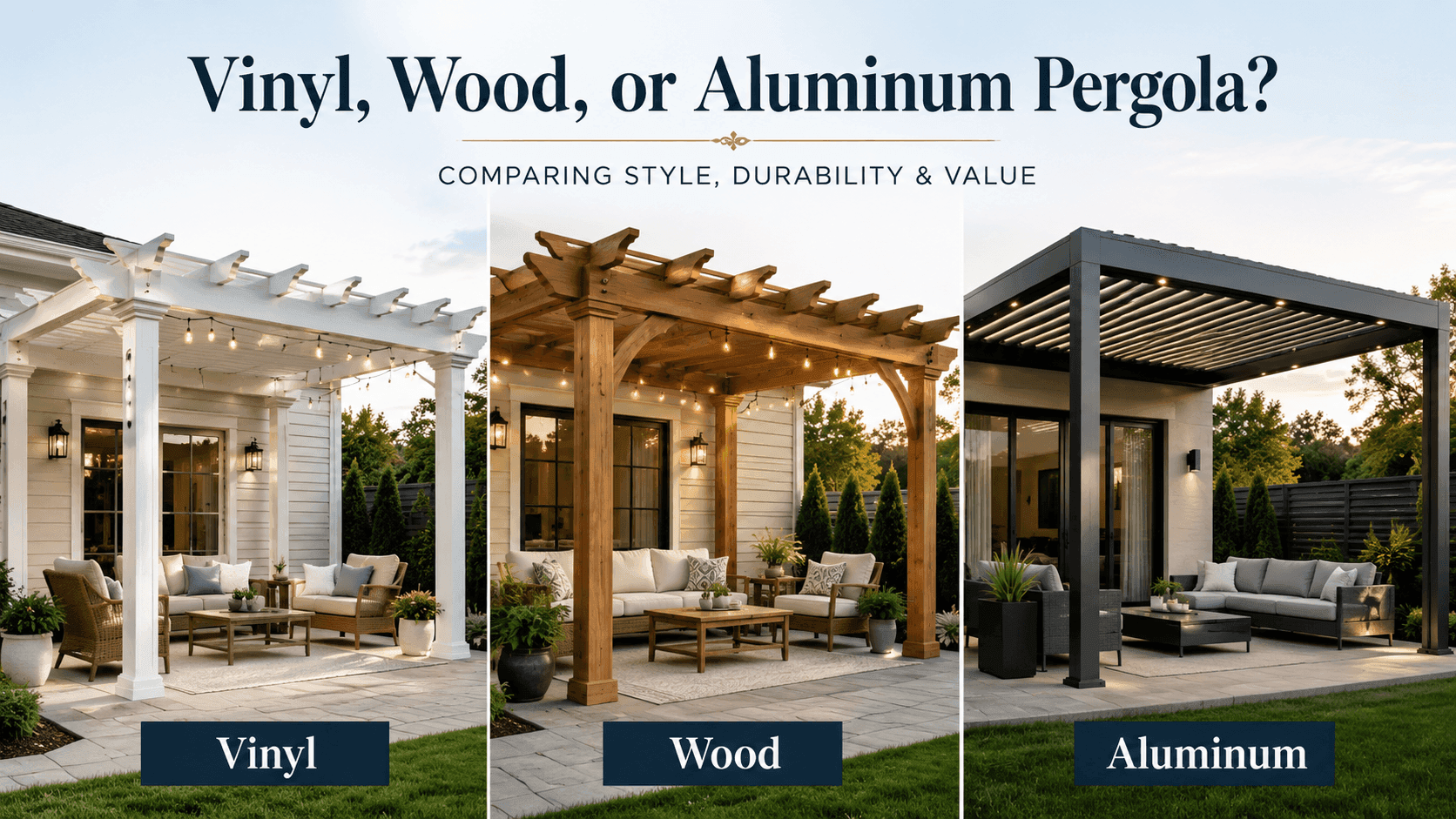
Comparison of Vinyl, Wood, and Aluminum: A Quick Overview
Vinyl
Budget-Friendly- Requires little painting, staining, or sealing
- Resistant to rot, insects, and moisture
- Lightweight and relatively easy to install
- Limited colors and customization options
- May fade, crack, or become brittle over time
- Less suitable for large or heavy-duty structures
Best for: Homeowners looking for an affordable,
low-maintenance pergola for a standard residential patio.
Wood
Classic Look- Warm, natural appearance
- Easy to cut, shape, paint, and customize
- Works well with traditional garden designs
- Requires regular staining, sealing, or painting
- Can rot, warp, crack, or attract insects
- Higher long-term maintenance costs
Best for: Residential projects that prioritize
natural appearance and flexible on-site customization.
Aluminum
Best Overall- Resistant to rust, rot, insects, and moisture
- Low maintenance and long service life
- Suitable for motorized louvers and accessories
- Higher upfront cost than basic vinyl or wood kits
- Professional installation may be required
- Low-quality finishes may scratch or fade
Best for: Residential and commercial projects that
require durability, modern design, weather resistance, and customization.
Note: Performance varies greatly based on material grade, UV stabilizer content and coating technology. Premium vinyl & fluorocarbon-coated aluminum deliver far better long-term weather resistance than entry-level options.
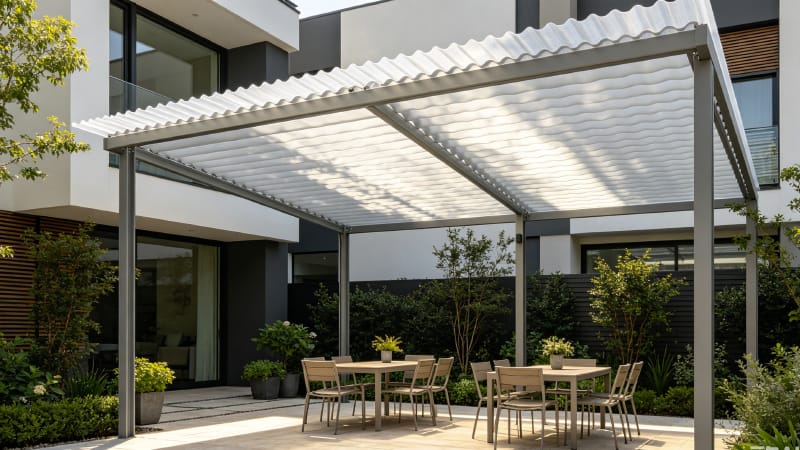
Vinyl (PVC) Pergolas: Low Cost, Limited Lifespan
Vinyl pergolas occupy the entry-level price bracket, typically $2,000 to $5,000 for a standard kit. The material offers inherent rot resistance and requires no painting. These advantages come with structural limitations that become apparent within the first few years.
Thermal performance
PVC becomes brittle at temperatures below -5°C. In regions with freeze-thaw cycles, post cracking is a documented failure mode — not a rare occurrence. Darker vinyl colors absorb heat and warp in direct summer sun, while lighter colors yellow from UV exposure over 3-5 years.
Structural limitations
Vinyl posts are hollow extrusions with minimal load-bearing capacity. Under lateral wind loads above 60 km/h, the structure flexes noticeably. This flex cycling loosens mechanical connections over time. Unlike aluminum or steel, vinyl cannot be reinforced after manufacturing — there is no welding, no internal sleeve option, no field repair beyond full component replacement.
Repairability
When a vinyl post fails, the entire section requires replacement. Color matching between new and weathered components is inconsistent. If the manufacturer has discontinued the color or profile, the entire structure may need replacement rather than repair.
For temporary installations or budget-constrained projects with a planned lifespan under 5 years, vinyl serves its purpose. For permanent outdoor structures, the material’s limitations outweigh its cost advantage.
Wood Pergolas: Traditional Aesthetics, Continuous Maintenance
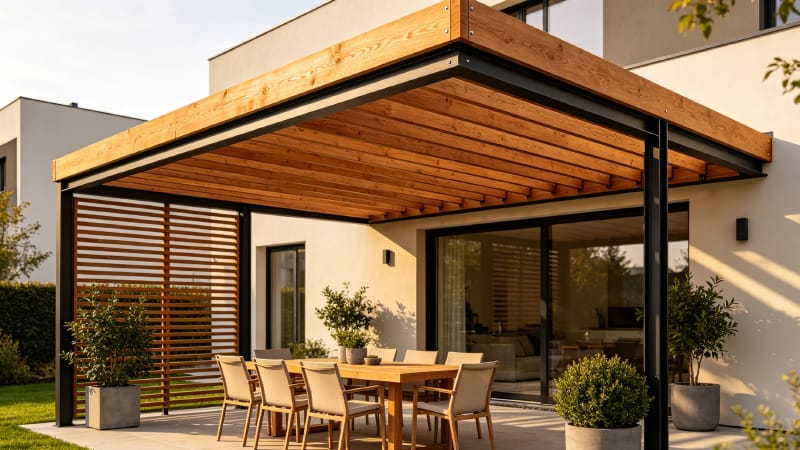
Cedar, redwood, and pressure-treated pine remain popular for their natural appearance. A well-constructed cedar pergola can last 15-20 years — provided the maintenance schedule is followed without interruption.
The realities of maintenance you need to know
Wood pergolas require sanding, cleaning, and re-staining or re-sealing every 2-3 years. Each cycle costs $200-$400 in materials and takes a full weekend of labor. Miss one cycle, and moisture ingress begins. Moisture leads to surface cracking, which allows deeper moisture penetration, which accelerates rot. Once rot establishes in a post or beam, the affected component must be replaced — a structural repair, not a cosmetic one.
Over a 10-year period, wood pergola maintenance costs total $1,000-$2,000. Over 15 years, $1,500-$3,000. These figures exclude the labor cost of the homeowner’s time.
Structural considerations for modern designs
Wood’s weight creates challenges for adjustable-roof designs. A wooden louvered roof requires motors with significantly higher torque ratings than aluminum equivalents. Most motorized pergola manufacturers work exclusively with aluminum for this reason. Traditional fixed-slat wood pergolas avoid the motor problem but offer no weather protection — rain, wind, and angled sun pass through unimpeded.
Ground contact
Where wood posts meet concrete or soil, moisture wicks upward even with proper flashing. This is the most common failure point for wooden pergolas, and it typically develops invisibly — the exterior looks intact while internal rot progresses.
Wood pergolas remain a valid choice for buyers who value the natural aesthetic above all else and accept the ongoing maintenance commitment. For buyers prioritizing long-term durability and minimal upkeep, other materials offer stronger value.
Aluminum Pergolas: Engineered for Lifespan
Aluminum pergolas represent the highest upfront investment of the three materials, with motorized louvered systems ranging from $2,000 to $12,000 depending on size, motor specification, and accessories. The value proposition rests on near-zero maintenance and a 15-25 year service life.
Corrosion resistance. Aluminum forms a natural oxide layer that prevents rust.
Unlike steel, which requires intact powder coating to avoid oxidation, aluminum’s corrosion resistance is inherent to the material. Powder coating adds UV protection and color retention, with quality manufacturers applying coatings of 80+ microns and validating durability through ASTM B117 salt spray testing at 2,000+ hours.
Weight advantage
At approximately one-third the density of steel and significantly lighter than solid timber, aluminum allows for:
- Smaller, quieter louver drive motors with longer service intervals
- Reduced foundation requirements (standard concrete pad rather than reinforced footings)
- Lighter roof structures that place less dead load on decking or pavers
- Easier handling during installation, reducing labor costs and installation time
Functional capabilities
Modern aluminum pergolas integrate features wood and vinyl cannot support: motorized adjustable louvers rotating from 0° (fully closed, waterproof seal) to 135° (fully open), built-in gutter channels routing rainwater through internal post downspouts, recessed LED lighting with internal wiring, and wind/rain sensors for automated operation.
Quality differentiation
Not all aluminum pergolas are equivalent. Critical specifications include:
- Alloy grade: 6063-T5 minimum for structural components
- Wall thickness: 2.0mm minimum on posts, 1.5mm on louvers
- Powder coating: 60 microns minimum, 80+ preferred, validated with salt spray testing
- Motor brand: DOOYA, Somfy , ANTUATOR or equivalent with documented cycle-life ratings
- Drainage design: Integrated gutter channels with EPDM seals at all joints
Material Decision Framework
| Factor | Vinyl | Wood | Aluminum |
|---|---|---|---|
| Upfront Cost | $2K–$5K | $2.5K–$6K | $2K–$12K |
| 10-Year Maintenance | $0 (replacement likely) | $1K–$2K | Under $500 |
| Typical Lifespan | 5–8 years | 10–15 years | 15–25 years |
| Weather Protection | None | None | Waterproof when closed |
| Motorized Option | ✕ | Rarely practical | ✔ Standard |
| Repairability | Poor (replace only) | Moderate | Good (modular components) |
The optimal choice depends on the buyer’s priorities. For a structure intended to last, aluminum’s higher initial cost is offset by near-zero maintenance and twice the service life of wood. For buyers who plan to move within 5 years, wood or vinyl may make more financial sense — but the structure stays with the property, and the next owner inherits the maintenance burden.
Greenawn Motorized Louvered Pergola: The Ultimate Aluminum Pergola Choice
Aluminum pergola manufacturing involves precision extrusion, CNC machining, powder coating chemistry, motor integration, and weather-sealing engineering. These are not general carpentry skills. A manufacturer’s track record in aluminum specifically is a strong indicator of product reliability.
Greenawn has specialized in aluminum pergola manufacturing since 1997 — 29 years focused on pergola.
For wholesale buyers and brands evaluating OEM or ODM partnerships, this depth of specialization means the manufacturer has already solved the engineering challenges that newer entrants are still discovering — drainage at every louver angle, motor torque optimization across temperature ranges, powder coating adhesion on complex extrusion profiles, and long-term UV stability across color options.
You might also be interested in...
OEM/ODM Solutions to Elevate Your Outdoor Brand Value
Ready to take your outdoor product line to the next level? Contact Greenawn. Let us help you elevate your brand with our bespoke solutions tailored for the outdoor industry.
Phone
+86 13622239259
sale2@greenawn.com.cn, sale15@greenawn.com.cn
Find us Here
Building A, No. 13 Bangyan Road, Dalong Street, Panyu District, Guangzhou